
Battery & backup · Fort Mill, SC
Solar battery installation in Fort Mill, SC
Why this changed in 2026 · as of July 2026
In Fort Mill, Duke Energy Carolinas credits exported solar at roughly 2.6–4¢ per kWh while retail power costs your full retail rate. That means a kilowatt-hour you store and use yourself is worth roughly three to five times one you export. Storage in Fort Mill is now an economic decision as much as an outage-protection one.


Local storage case
Why storage does or does not fit in Fort Mill
Fort Mill needs an honest framing that differs from our coastal markets. Severe-weather outages here tend to be shorter than coastal hurricane events, which changes the backup case substantially. Sizing a battery for multi-day autonomy in York County is usually paying for capacity that will not be used, and we would rather size for the outages this area actually experiences than import a Lowcountry specification.
The economic case is the stronger one. Duke Energy Carolinas credits exported power at roughly 2.6 to 4 cents against your full retail rate, and York Electric Cooperative sets its own terms on the meters it serves. Either way, a commuter household that exports through the day and draws hard in the evening is losing value daily, and that daily gap is what a battery closes.
The newer housing stock makes installation predictable: modern services with capacity for a critical-loads subpanel, attached garages suitable for indoor equipment, and documented construction. The constraint is more likely to be the HOA's view on any visible external equipment, since architectural review is active in most of these subdivisions, so placement should be confirmed against the guidelines before a product is chosen.
Written for Fort Mill specifically. Your own roof, bill and meter still decide the answer, which is what the free assessment settles.
The maths changed
Storing a kilowatt-hour now beats exporting one
One-for-one net metering closed to new applicants on 1 June 2021, and new Duke Energy Carolinas systems are credited under Duke's current residential solar rate structure instead, at roughly 2.6–4¢ per kWh for exports. Sending surplus power to the grid is no longer almost as good as using it, which is what changes the case for a battery in Fort Mill.
You still buy power at your full retail rate. The gap between that and what an export earns is the entire case for storage.
A battery closes that gap. Instead of exporting afternoon surplus for a few cents and buying evening power back at full retail, you store the surplus and spend it yourself. For a household that is out during the day and home in the evening, this is the difference between a system that barely moves the bill and one that does what you expected.
We are not going to promise you a figure for that, because it depends on your usage shape and your rate. What we will do at the assessment is model your actual load profile against your actual rate and show you whether storage earns its cost at your address.
See the full rate picture on Fort Mill solar incentives, and how self-consumption drives payback on Fort Mill solar cost.
We handle everything
From critical-load mapping to switched-on
- 01
Critical-load mapping, not box-selling
We start from what you actually need running in an outage and what your Duke's current residential solar rate structure rate structure rewards. Backing up essentials well beats undersizing a whole-house dream, and it costs less.
- 02
Permits, Duke Energy Carolinas interconnection and HOA
York County requires a separate electrical permit for storage on top of the solar permits. We pull all of it, file the interconnection, and prepare the architectural-review packet where a board or HOA is involved.
- 03
Installation and critical-loads panel
Our crews install the battery and tie it to a critical-loads subpanel with automatic switchover, so backup engages the moment the grid drops. No manual steps, no extension cords.
- 04
Commissioning and monitoring
We commission the system, walk you through the app so you can see state of charge and what is protected, and stay reachable long after activation.
Every battery install carries our lifetime full-system and roof-penetration warranty, on top of the manufacturer's battery warranty.
Honest numbers
What drives battery cost in Fort Mill
There is no honest fixed price for a battery. These are the real drivers, and a free assessment turns them into a figure for your home.
Usable capacity
How many kilowatt-hours you want available, and whether you stack more than one unit. This is the largest single factor.
Electrical work
Adding a critical-loads subpanel, and any service-panel upgrade your home needs first. Common on older Fort Mill properties.
Retrofit or new build
Pairing storage with a new system is cleaner than retrofitting to an existing inverter that was never specified for it.
Fort Mill specifics
What storage involves here
Fort Mill has its own constraints. Getting these right is most of the job.
- 01
A separate electrical permit
York County requires one for storage on top of the solar permits, with its own inspection. We pull it and meet it.
- 02
Your outage profile
Upstate summers drive strong afternoon cooling load. Severe-weather outages here tend to be shorter than coastal hurricane events, which changes the backup case from resilience to convenience for many households.
- 03
Where the battery goes
Placement matters mostly for heat. Batteries dislike an unconditioned attic or a west-facing wall in a Midlands summer, so garage-interior siting is usually right.
- 04
Service panel capacity
Older services often need attention before storage can be added cleanly. We run the load calculation before quoting, not after.
- 05
Battery or generator?
For very long outages a standby generator can be the better answer, and we will say so if it is. Compare the two.
- 06
Retrofit or new build
Pairing storage with a new system is cleaner than retrofitting to an inverter that was never specified for it. We check yours first.
Permits and approvals
What approval takes in Fort Mill
This is the part most quotes leave vague, and it is the part that decides how long a job takes. Below is what a system at a Fort Mill address actually has to clear. We handle all of it, and you file none of it yourself, but you should know what you are agreeing to a timeline for.
- 01A building permit and a separate electrical permit for a rooftop system
- 02Standard plan review for systems of roughly 10 kW and above
- 03A zoning review as well for any ground-mounted array
- 04An additional electrical permit where battery storage is included
- 05Structural review under York County requirements
- 06HOA architectural-review approval, which is common here and which we prepare
- 07Duke interconnection approval before the system is allowed to energise
Rebate:Duke's PowerPair solar-and-battery incentive has been at or near capacity in Carolinas territory, so it should not be assumed available. Duke's battery bill-credit programme has remained open and pays monthly rather than up front. We check live status for your address before it forms part of any number we give you.
Requirements are read from the authority that reviews your address, not assumed from the county. In SC that distinction is routinely the difference between a permit issued and a permit returned.
Our work
Real systems our crews have installed
Genuine job photos, not stock images and not renders. Every system here was designed, permitted and installed by our own crews, and the same crews cover Fort Mill.Well inland in the Charlotte metro orbit, so no salt exposure and moderate wind loading.
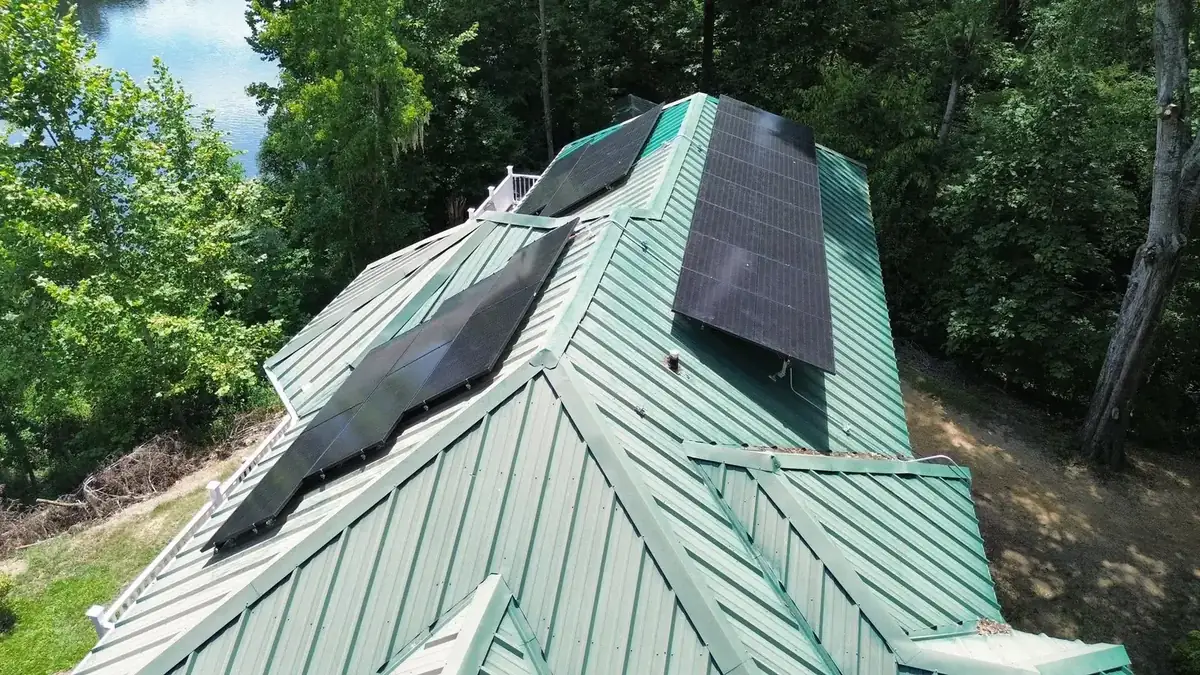 ResidentialStanding-seam metal roofLakeside multi-facet install
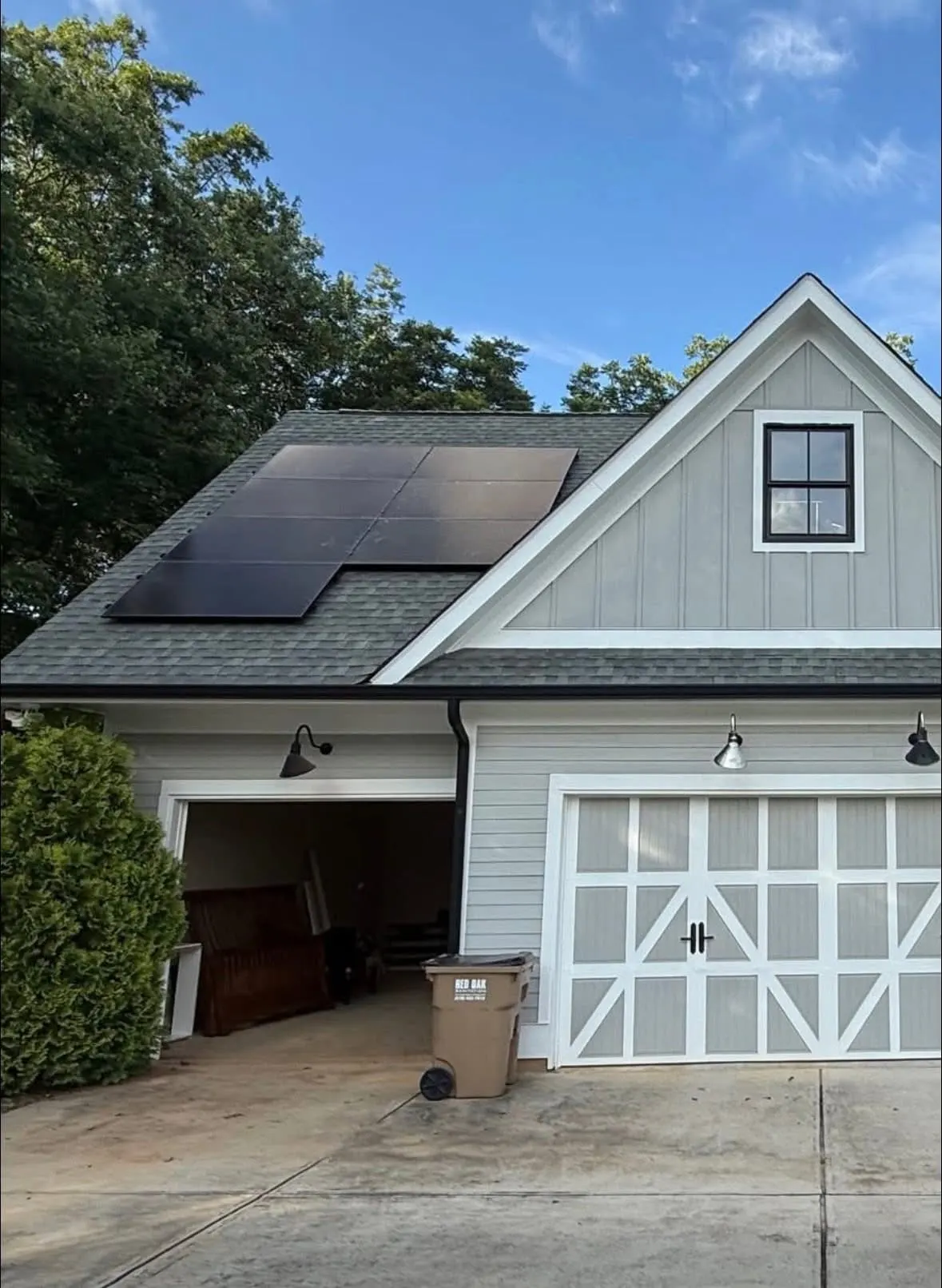 ResidentialDetached garage arrayFarmhouse-style home
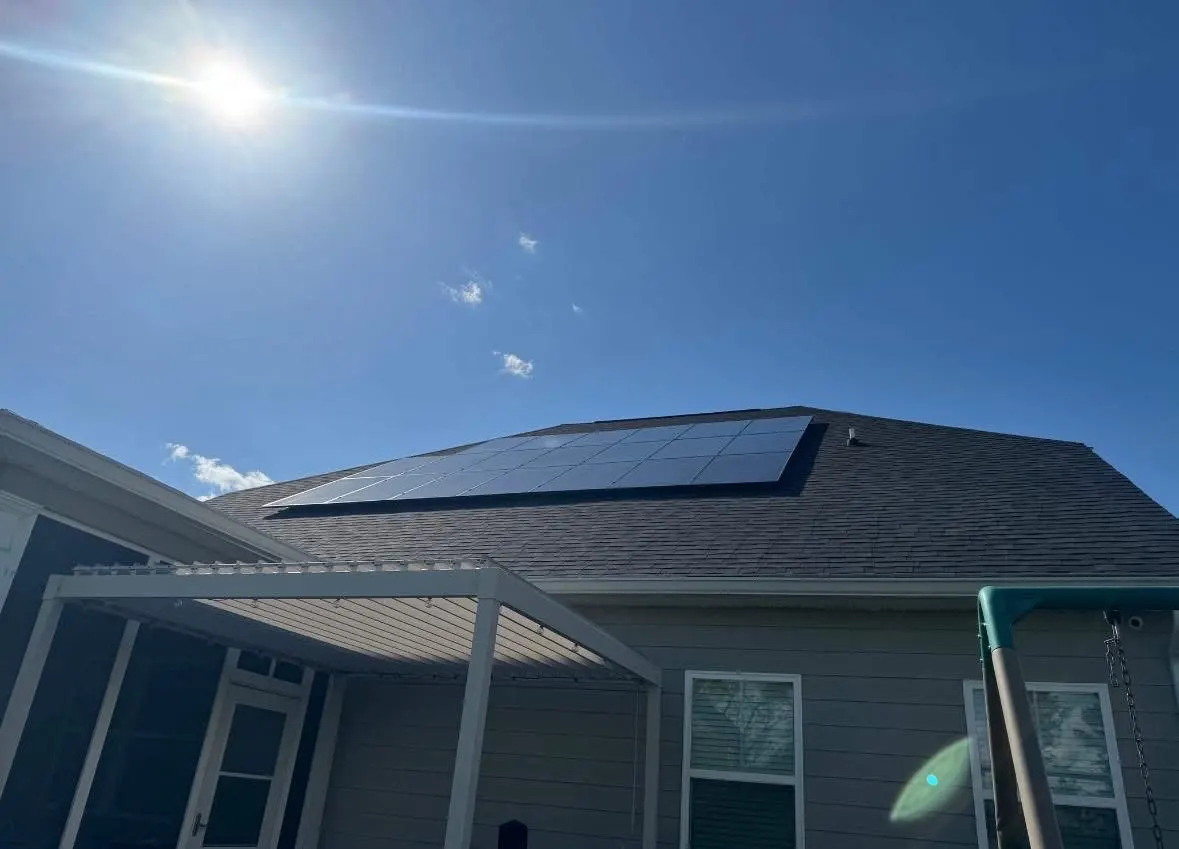 ResidentialShingle rooftop arrayBackyard-facing slope
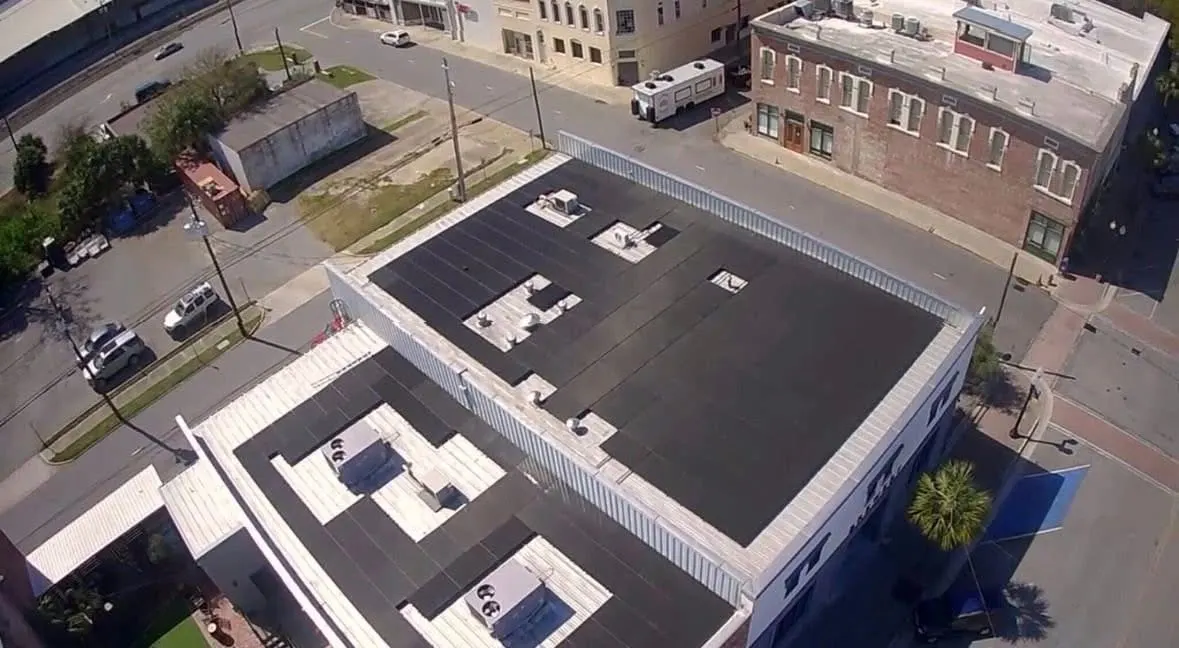 CommercialDowntown flat roofLow-slope membrane rooftop
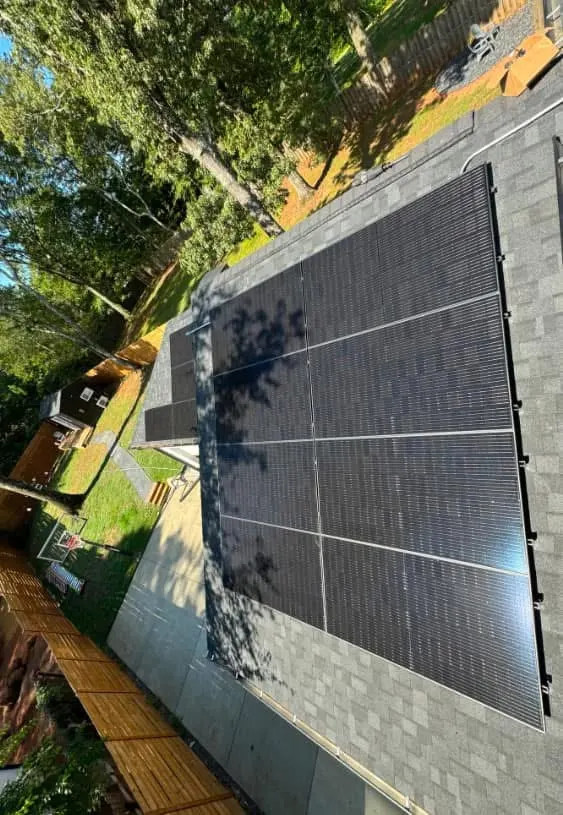 ResidentialClean rooftop layoutBlack-framed panels
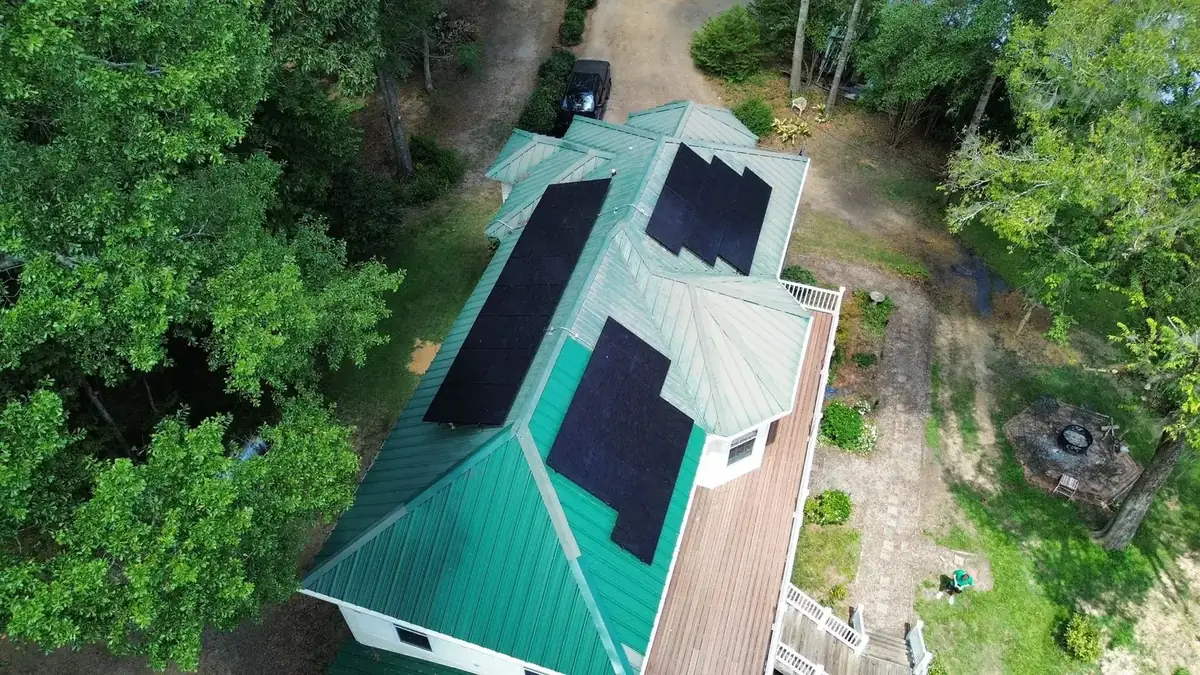 ResidentialMulti-facet metal roofWooded aerial view
Photo locations are not published at customer level. Where a customer has agreed to it, we name the job and the market on the completed-job records above.
Free assessment · Fort Mill, SC
Get a straight answer for your Fort Mill roof
We read your bill, confirm your Duke Energy Carolinas export terms, and tell you what your roof in York County will actually carry. If solar does not make sense at your address, we will say so, and that answer is free too.
- We confirm whether Duke Energy Carolinas or York Electric Cooperative serves many addresses here serves your meter before we quote anything
- Permitting runs through A building permit and a separate electrical permit for a rooftop system, and we handle it
- Heavy HOA density in the newer subdivisions, with active architectural review and real rules on street visibility.
Prefer to talk? (843) 310-1128
Fort Mill battery FAQ
Battery questions from Fort Mill homeowners
Is a home battery worth it in Fort Mill in 2026?
The economics improved when net metering changed. Duke Energy Carolinas credits exported power at roughly 2.6–4¢ per kWh while you buy power at your full retail rate, so a kilowatt-hour you store and use yourself is worth roughly three to five times one you export. That is a stronger case than under the old one-for-one net metering, on top of the outage protection.
How long will a battery run my house during a Fort Mill outage?
It depends on usable capacity and what you back up. Most homeowners back up essentials, refrigerator, lights, Wi-Fi, well pump, medical equipment, a few outlets, which stretches runtime far longer than trying to run central air. During your assessment we map your critical loads so you know realistically what to expect rather than a marketing number.
Can I add a battery to solar I already have in Fort Mill?
Usually yes. Many existing systems can be retrofitted with a battery and a critical-loads panel. We check your current inverter, panel capacity and interconnection status first, and tell you honestly whether it is a clean add-on or needs additional equipment.
Do I need solar to get a battery?
No. A battery can be installed on its own to back up your home from the grid, though pairing it with solar lets you recharge from your own panels instead of only from the utility. We will walk through both options based on your goals.
Does battery storage need a separate permit in York County?
Yes. Battery storage requires an additional electrical permit alongside the permits for the solar system itself in York County, and the installation must satisfy the National Electrical Code as adopted in South Carolina. We pull the permits and handle the inspection sequence as part of the project.
Does a battery qualify for South Carolina’s 25% state tax credit?
Battery storage paired with solar may qualify for South Carolina’s 25% state tax credit, subject to the same annual cap and eligibility rules as the rest of the system. The expired federal credit no longer applies. Confirm your own position with a tax professional.
Nearby
Battery storage near Fort Mill
Keep reading
Battery storage guides
- Solar Planning
Richmond Hill Battery Permits: Documents and Approval Checks
Plan a Richmond Hill solar battery project with the correct city or county route, current utility documents, revision records and documented commissioning.
16 min read - Battery Storage
Battery Backup for Georgia Well Pumps: Starting Power and Water Use
Evaluate Georgia well-pump battery backup using motor records, voltage, startup behavior, water demand, pressure controls and a documented installation scope.
16 min read - Battery Storage
AC-Coupled vs DC-Coupled Solar Batteries
Compare AC-coupled vs DC-coupled solar batteries for retrofits, new systems, backup behavior, compatibility, expansion, and quote scope in South Carolina.
28 min read - Battery Storage
Adding a Battery to Existing Solar: Compatibility and Approval
Learn what changes when you add a battery to existing solar, including Georgia utility approvals, inverter compatibility, backup circuits and quote scope.
23 min read - Battery Storage
The Home Battery Installation Process in South Carolina
Follow a South Carolina home-battery project from outage brief and site review through design, approvals, installation, commissioning, and handoff.
22 min read - Battery Storage
Where to Install a Home Battery: Siting, Climate and Warranty
Compare home battery locations, coastal Georgia exposure, manufacturer warranty conditions and permit questions before approving a placement plan.
31 min read
Free, no-pressure assessment
See whether storage earns its cost at your Fort Mill address
We will map your critical loads, model your usage against your actual rate, and tell you honestly whether a battery pays for itself here or whether it is purely backup insurance.
Mon–Sat, 10am–6:30pm ET · We typically follow up within the hour.