
For most Hilton Head homes, a solar battery paired with rooftop panels outlasts a standalone generator once a storm knocks out power for several days, because it recharges free from sunlight and needs no fuel deliveries. A generator still wins on raw, immediate output for whole-home loads, but it depends on a fuel supply chain that often breaks down right when you need it most. The right answer for your address usually comes down to budget, how long outages typically last in your neighborhood, and whether you already have solar.
Key Takeaways
New 2026 homeowner solar or battery installations do not qualify for the expired federal Residential Clean Energy Credit. Battery capability and outage resilience are engineering decisions, not proof of tax eligibility. Confirm any South Carolina benefit for the exact equipment, ownership and project; do not presume a battery or standby generator receives a homeowner federal solar credit. See current IRS Section 25D guidance.
Solar Battery vs Generator at a Glance
| Factor | Solar Battery Storage | Backup Generator |
|---|---|---|
| Typical upfront cost (installed) | Higher initial investment, offset by tax credits | Lower for portable units, comparable for whole-home standby |
| Ongoing fuel cost | None; recharges from sunlight or grid | Propane, natural gas, or diesel, which rises during storm demand |
| Noise level | Silent operation | 60-70 decibels while running |
| Maintenance | Minimal; occasional monitoring checks | Regular oil changes, filter swaps, monthly test runs |
| Multi-day outage performance | Sustained with daily solar recharge | Limited by on-site fuel supply |
| Federal tax treatment | No new homeowner Section 25D credit for 2026 installations | No new homeowner Section 25D credit for 2026 installations |
| Best paired with | New or existing solar panel system | Can run independently or alongside solar |
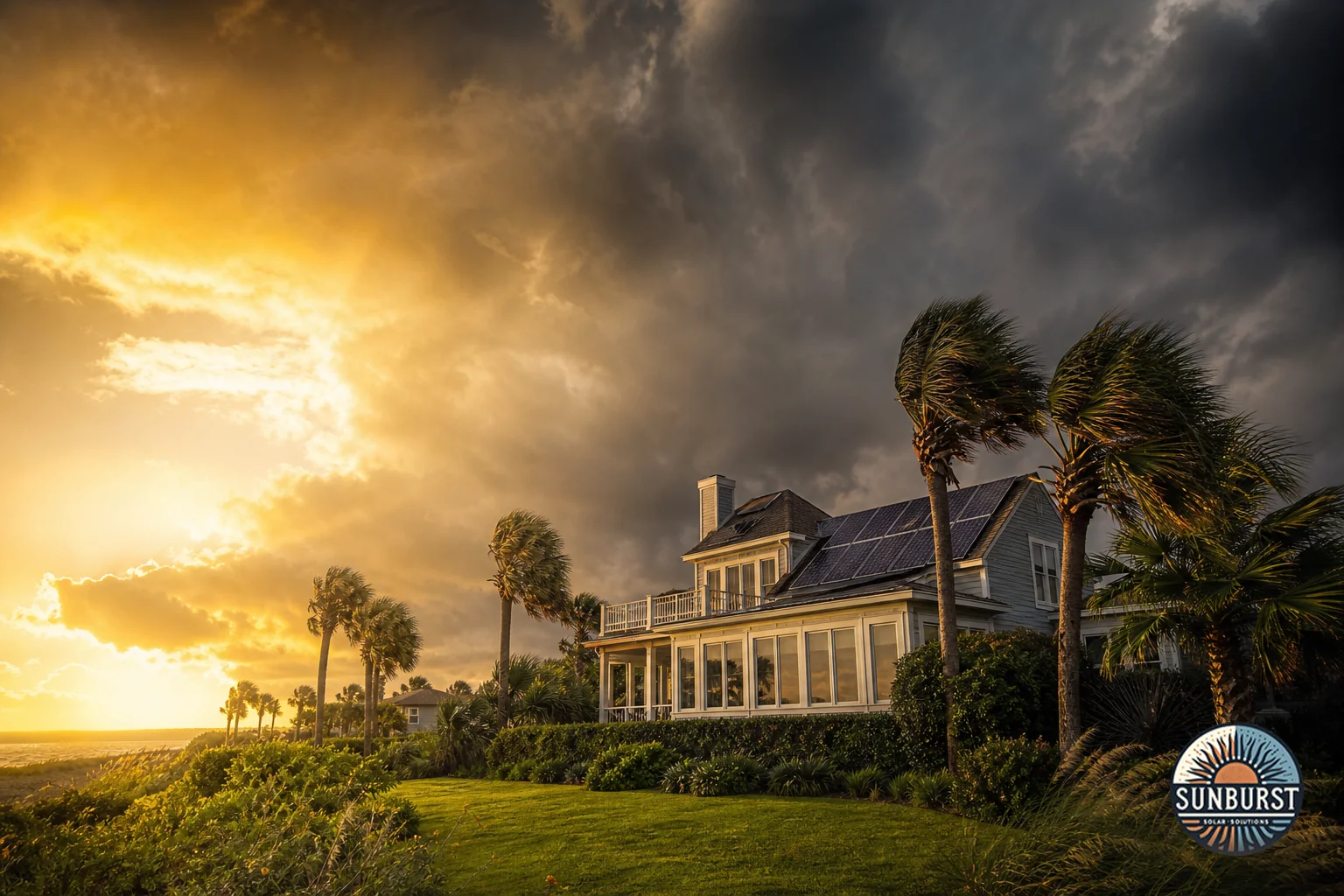
Why Hilton Head Homeowners Are Rethinking Backup Power
Ask anyone who has lived through a mandatory evacuation on Hilton Head Island, and they’ll tell you the storm itself is only half the problem. Hurricane Matthew, Irma, and Debby each left thousands of Lowcountry homes without power for days, sometimes longer than a week in the hardest-hit pockets near Sea Pines and Port Royal Sound. Once the causeway reopens and residents return, the real test begins: keeping refrigerators cold, medical equipment running, and sump pumps working until the grid comes back.
That reality has pushed more homeowners here to compare solar battery vs generator Hilton Head options seriously, rather than treating backup power as an afterthought. It’s not just about weathering one storm. Barrier island living means salt air, humidity, and seasonal flooding put extra strain on any equipment left outdoors, so the choice you make needs to hold up year after year, not just survive a single hurricane season.
Many residents also want backup power that pulls double duty. A system that only turns on during emergencies sits idle 360 days a year. One that saves money on electric bills the rest of the time delivers value whether or not a storm ever forms in the Atlantic.
How Backup Generators Work
Backup generators fall into two broad categories: portable units you wheel out and connect manually, and standby generators wired directly into your home’s electrical panel with an automatic transfer switch. Standby models detect an outage and kick on within seconds, usually running on propane or natural gas piped to the unit. Portable generators run on gasoline or diesel and require you to manually start them and connect appliances with extension cords or a transfer switch.
Runtime depends entirely on fuel supply. A whole-home standby generator connected to a large propane tank can run for several days without refueling, but a portable unit on a five-gallon gas can might only last eight to ten hours before you’re searching for an open station. During a Hilton Head evacuation order, that search can mean driving well off the island since local stations often run dry or lose power themselves.
Installing a standby generator involves permitting, gas line work, and an electrical connection that typically requires a licensed contractor. If you’re weighing backup generator installation hilton head island options, factor in placement rules too. Beaufort County and most island HOAs require generators to sit a minimum distance from windows and property lines because of exhaust fumes and noise.
How Solar Battery Storage Works
A home battery stores energy pulled from your solar panels during the day, then releases it when the grid goes down or when electricity rates spike. An inverter manages the flow between panels, battery, and home, and most modern systems switch over automatically within a fraction of a second, so you may not even notice the outage happened.
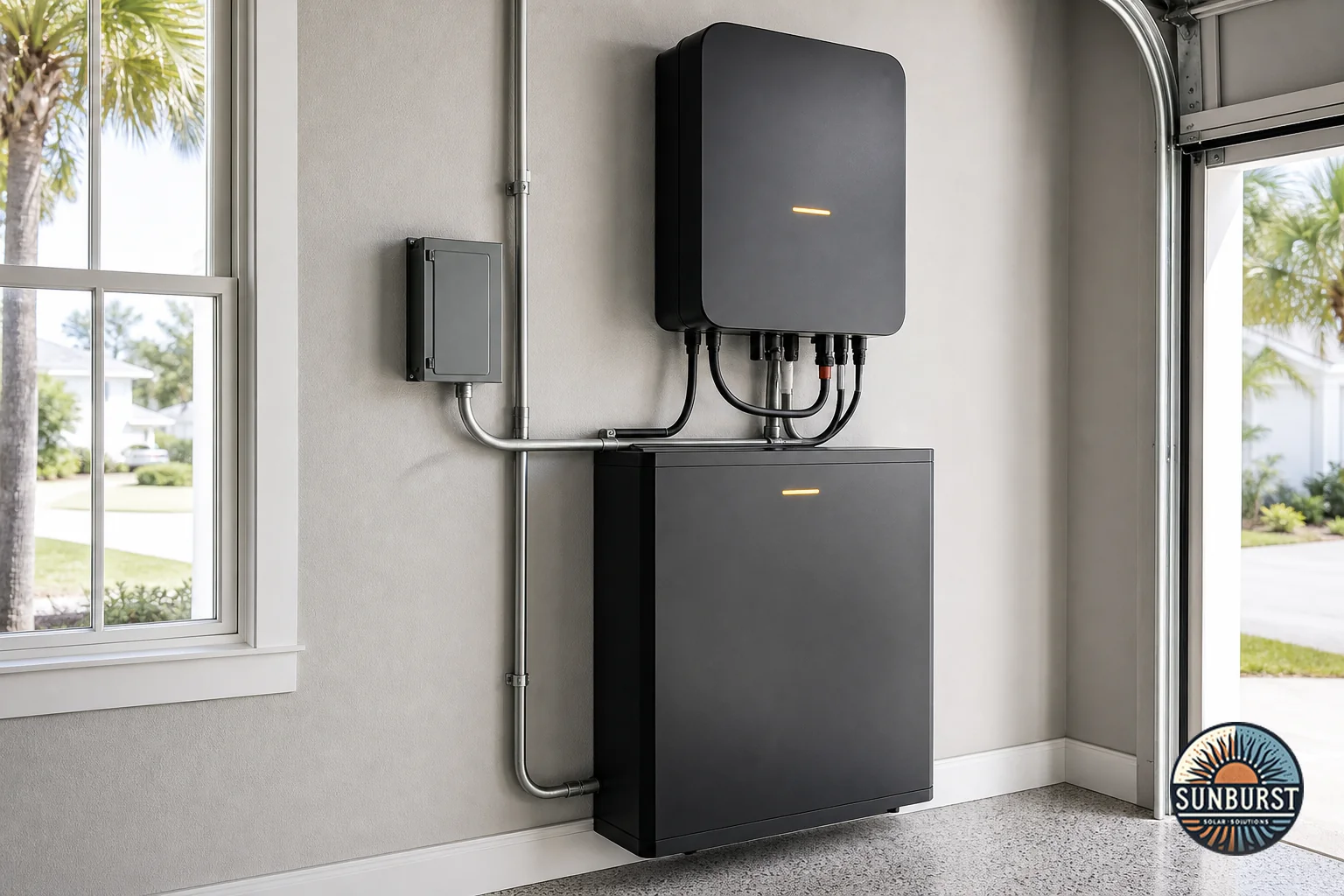
Unlike a generator, a battery doesn’t burn anything to produce power. As long as the sun comes up the next morning, panels start refilling the battery, which means a multi-day outage doesn’t necessarily drain your reserve to zero. Homeowners who pair storage with an existing solar array, or install both together, get a system that quietly handles small everyday outages and larger storm-driven ones without you lifting a finger.
Sizing matters here. A battery that’s too small for your home’s critical loads, think refrigerator, well pump, medical devices, and a few outlets, will drain faster than expected. Sunburst Solar Solutions walks Hilton Head homeowners through how to size a battery storage system correctly before installation, so the unit matches actual household demand rather than a generic estimate.
Solar Battery vs Generator: Full Comparison
Here’s a deeper side-by-side look at how these two backup options compare across the factors that matter most to coastal South Carolina homeowners.
| Comparison Point | Solar Battery | Standby Generator | Portable Generator |
|---|---|---|---|
| Startup during outage | Instant, automatic | Seconds, automatic | Manual, several minutes |
| Fuel source | Sunlight (self-recharging) | Propane or natural gas | Gasoline or diesel |
| Noise while running | Silent | Moderate, engine hum | Loud, often near property line |
| Multi-day storm reliability | High, recharges daily | High if fuel tank is large | Low, limited by fuel storage |
| Maintenance frequency | Minimal, remote monitoring | Every 100-200 run hours | Before and after each use |
| Lifespan | 10-15 years typical | 15-20 years with upkeep | 8-10 years typical |
| Daily energy bill savings | Yes, offsets peak-rate usage | No | No |
| Federal tax treatment | No new homeowner Section 25D credit for 2026 installations | No new homeowner Section 25D credit for 2026 installations | No new homeowner Section 25D credit for 2026 installations |
The pattern here is consistent: a generator, especially a portable one, gives you a fast answer for a short outage, but the longer the storm’s aftermath drags on, the more the fuel-dependency problem grows. A battery’s advantage compounds the longer the grid stays down, provided there’s enough daylight to recharge it.
Upfront Cost and Long-Term Value
Portable generators are the cheapest entry point, often a few hundred to around a thousand dollars for the unit alone, though they offer the least resilience. Whole-home standby generators cost considerably more once you add the automatic transfer switch, gas line work, and permitting, frequently landing in a range comparable to a mid-size solar battery installation.
New 2026 homeowner solar or battery installations do not qualify for the expired federal Residential Clean Energy Credit. Do not treat an ordinary roof replacement or structural roof work as a solar tax-credit expense. Older eligible projects and solar-generating equipment have distinct tax rules; verify them independently rather than financing roof work around an assumed federal refund. See current IRS Section 25D guidance.
There’s also the ongoing cost gap. Fuel prices climb during hurricane season as demand spikes across the entire region, and a standby generator burns through propane at a steady clip once it’s running for days. A solar battery’s “fuel” is sunlight, so beyond the initial investment, there’s no recurring cost tied to keeping the lights on. For a detailed breakdown of what drives battery pricing up or down, see our guide on how much does home battery storage cost.
Fuel Logistics During Multi-Day Storm Outages
This is where the comparison gets real for anyone who has actually ridden out a storm on Hilton Head. When a hurricane approaches, gas stations across Beaufort County see lines stretch for blocks, and many run out entirely before the storm even makes landfall. Propane suppliers face the same crunch, and delivery trucks can’t reach the island until roads reopen and debris gets cleared.
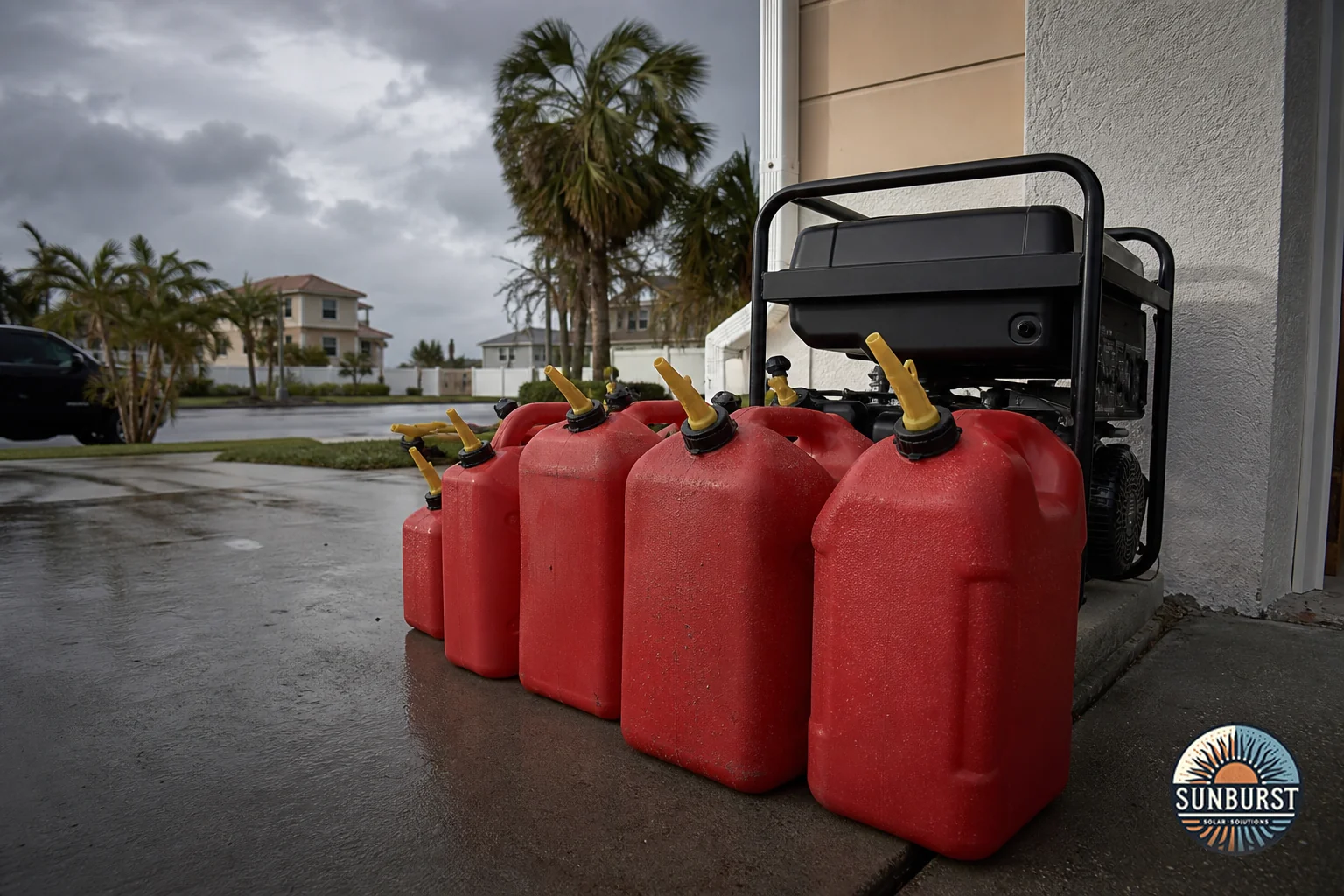
If you’re relying on a portable generator and the storm knocks out power for five or six days, which is not unusual in hard-hit areas, refueling becomes its own emergency. Some homeowners end up rationing generator use to a few hours a day just to stretch limited fuel, running it only long enough to keep the refrigerator cold.
A solar battery sidesteps that entire supply chain problem. Once clouds clear, even partially, panels start feeding the battery again. It’s not a perfect solution during an extended stretch of heavy overcast skies, but it removes the single biggest failure point that generators face: running out of something you can’t buy because everyone else needs it too.
Noise, Maintenance, and Neighborhood Considerations
Hilton Head’s plantation communities and gated neighborhoods tend to have strict covenants, and generator noise is a common source of complaints, especially when a unit runs continuously for days after a storm while neighbors are trying to clean up and sleep. Standby generators typically run in the 60-70 decibel range, comparable to a running dishwasher, but sustained over 24 hours in close quarters, that adds up.
Generators also need regular upkeep to be ready when a storm hits: oil changes, air filter replacement, and monthly self-test cycles that themselves generate noise. Skip maintenance for a season or two, and there’s a real risk the unit won’t start when you need it most.
Batteries ask far less of you. Most systems include remote monitoring so you, or your installer, can check charge status and performance without stepping outside. If you’re already navigating hoa solar panel approval columbia sc style requirements for solar panels, know that battery units typically face fewer placement restrictions than generators, since they don’t produce exhaust fumes or the same noise profile. Still, always confirm setback and screening rules with your HOA before installation.
Can You Combine Solar, Battery, and Generator?
You don’t have to pick just one. A growing number of Hilton Head homeowners run a hybrid setup: solar panels and a battery handle daily energy use and quiet, everyday backup, while a smaller generator sits in reserve for the rare stretch of days-long overcast weather that outlasts the battery’s reserve.
This layered approach makes sense for households with higher critical loads, like whole-home air conditioning or medical equipment, where a single battery might not stretch far enough across a week without much sun. The generator becomes a safety net rather than the primary plan, which also means less fuel consumption overall since it’s not doing all the work.
Sunburst Solar Solutions designs these hybrid systems around your home’s actual usage patterns rather than a one-size-fits-all package. That includes reviewing your roof’s solar exposure, your typical monthly usage, and which appliances truly need to stay powered during an outage, then building a battery (and, if needed, generator) plan around those numbers.
Which Option Fits Your Hilton Head Home?
A few honest questions help narrow this down before you commit to either path:
- Do you already have solar panels? If so, adding battery storage is usually the more natural next step, since the infrastructure to charge it is already on your roof.
- How long do outages typically last in your area? Neighborhoods closer to the causeway sometimes see faster restoration than more remote parts of the island; check your outage history if you have it.
- What’s your HOA’s stance on generators versus solar equipment? Some communities have stricter rules for one than the other.
- What’s your budget, including incentives? Run the numbers with tax credits factored in before ruling out a battery on price alone.
- Do you want backup power that also lowers your monthly bill? Only a battery-plus-solar setup does both jobs.
If your main concern is a short, occasional outage and budget is tight, a generator alone can be the practical choice. If you’re thinking longer term, about hurricane resilience across many seasons, plus daily savings on rising utility rates, a solar battery earns its higher upfront cost back over time in ways a generator simply can’t.
Frequently Asked Questions
How long can a solar battery power a Hilton Head home during an outage?
It depends on battery capacity and how much sunlight your panels capture each day. A properly sized battery covering essential loads, refrigeration, lighting, a few outlets, and a well pump, can often run indefinitely through a multi-day outage as long as there’s at least partial sun to recharge it daily.
Do I need solar panels to install a battery?
No, batteries can charge from the grid alone, but pairing one with solar panels gives you free daily recharging and unlocks the federal and South Carolina tax credits that apply to solar-paired storage.
Is a generator required by my HOA in Hilton Head communities?
Requirements vary by community. Some Hilton Head HOAs have specific placement, screening, and noise rules for generators, while others focus more on aesthetics for solar equipment. Always check your specific covenants, or ask your installer to help confirm what’s allowed.
What incentives apply to solar batteries in South Carolina in 2026?
New 2026 homeowner solar or battery installations do not qualify for the expired federal Residential Clean Energy Credit. Savings and payback should use the full installed scope, utility imports and export compensation, financing obligations and realistic replacement costs. A generic payback estimate based on the former federal homeowner credit is not a current property-specific forecast. See current IRS Section 25D guidance.
Can a generator and solar battery share the same electrical panel?
Yes, with proper design. Many hybrid systems integrate both through a single transfer switch setup, letting the battery handle everyday backup while the generator serves as a secondary source during extended low-sun periods.
Choosing backup power for a Hilton Head home isn’t just about surviving the next named storm. It’s about building a system that keeps working, season after season, without a fuel line or a supply run standing between your family and the essentials.
If you’re ready to move past guesswork and see what a solar battery could look like for your specific home, Check Your Solar Potential for a free, personalized estimate. For homeowners who want a deeper walkthrough of the installation process itself, our guide on solar installation in Charleston, SC covers what to expect from consultation through final inspection, much of which mirrors what Hilton Head installs look like too. When you’re ready to talk through your options with someone who knows the island’s storm patterns and HOA rules, Book Appointment with Sunburst Solar Solutions and get a plan built around your home, not a generic package. You can also Join Us to stay updated on incentive changes and hurricane-season readiness tips throughout the year.