


A battery that can’t run your well pump for more than an hour isn’t backup power, it’s a false sense of security. Learning how to size a battery storage system starts with adding up your actual essential loads in watts, not guessing based on your monthly electric bill or accepting a generic quote. Get the math right and you avoid two expensive outcomes: a system too small to matter, or one so oversized you paid for capacity you’ll rarely use.
Key Takeaways
- Load calculation comes first: List every circuit you want backed up (fridge, well pump, wifi, a few outlets) and add up the running watts before anyone talks battery models.
- kWh and kW are different numbers: Capacity (kWh) tells you how long a battery lasts; power output (kW) tells you what it can run at once. You need both to match your loads.
- Surge loads sink undersized systems: Well pumps, air conditioners, and some fridges pull 2-3x their running wattage for a second or two on startup. Skip this and the battery trips offline.
- Most South Carolina homes don’t need whole-house backup: A subpanel with 8-10 critical circuits is usually enough, and it costs meaningfully less than backing up the entire house.
- Outage duration goals drive stacking decisions: A single battery module often covers a few hours of critical loads; multi-day storm resilience usually means stacking two or more units, especially if paired with solar recharge.
Battery Sizing At a Glance
| Load Type | Typical Running Watts | Startup Surge | Backup Priority |
|---|---|---|---|
| Refrigerator/freezer | 150-400W | up to 1,200W | High |
| Well pump (1/2 HP) | 750-1,000W | 2,000-3,000W | High (if on well water) |
| Wifi router + modem | 20-40W | Negligible | Medium |
| Sump pump | 800-1,300W | 1,800-2,900W | High (flood-prone lots) |
| Central AC (per ton) | 1,200-1,500W | 3,000-5,000W | Low-Medium (heavy draw) |
| Medical equipment (CPAP, oxygen) | 30-300W | Negligible | Critical |
| Single battery module (typical) | 5-13.5 kWh usable | 5-7.6 kW output | Covers 4-8 critical circuits, several hours |

Why Battery Sizing Trips Up So Many South Carolina Homeowners
Most sizing mistakes don’t happen because a homeowner picked the wrong battery brand. They happen because nobody did the arithmetic before the contract got signed. A salesperson hears “I want backup power” and quotes a standard package built for an average house, not your house with a well pump, a sump pump, and a spouse on a home oxygen machine.
South Carolina adds its own wrinkle. Coastal counties see hurricane-driven outages that stretch for days, while inland areas near Columbia deal with ice storms that can knock out power for a week. A battery sized for a two-hour dinner-time blip won’t touch either scenario. If you’re also comparing backup options, our breakdown of solar battery vs generator setups for Hilton Head homes covers how storm frequency should factor into your choice.
The fix isn’t complicated, but it does take fifteen minutes with a pen and your breaker panel labels before you talk to any installer.
1. Start With a Real Essential Loads Calculation
Walk your breaker panel and write down what each circuit powers. Focus on what you truly need during an outage, not everything you’d like. A typical essential loads list for a South Carolina home includes:
- Refrigerator and freezer
- Well pump or sump pump, if applicable
- A few living room and bedroom outlets for lamps and phone chargers
- Wifi router and modem
- One or two window units or a portion of central AC
- Medical equipment specific to your household
- Garage door opener
Check the wattage label on each appliance, usually printed on a metal plate on the back or bottom. If you only find amps, multiply by 120 volts to get watts. Add these numbers together and you have your running load, the baseline number every battery sizing conversation should start with.
2. Decide Your Outage Duration Goal
A battery sized to survive a three-hour afternoon outage looks nothing like one built for four days without grid power. Before you compare quotes, decide which scenario you’re actually planning for.

If you live in a hurricane evacuation zone or a county with older infrastructure, plan for at least 48-72 hours of critical loads. If your outages are typically short and rare, a smaller single-battery system that covers a handful of hours may be all you need. This decision changes everything downstream: battery count, panel work, and total cost. It’s also the same conversation worth having if you’re weighing a generator installation on Hilton Head Island against battery-only backup, since generators refuel indefinitely while batteries need solar or grid recharge.
3. Convert Loads Into Battery Capacity (kWh) and Power (kW)
Two numbers matter here, and installers who skip explaining both are doing you a disservice. Kilowatts (kW) measure how much power the battery can deliver at one instant, essentially whether it can start your well pump. Kilowatt-hours (kWh) measure how much energy it stores in total, which determines how long your loads run before the battery is empty.
Here’s the simple math. If your essential loads add up to 1,200 running watts (1.2 kW) and you want 8 hours of backup, you need roughly 9.6 kWh of usable capacity (1.2 kW x 8 hours), plus a buffer for inefficiency, usually 10-15% more. Separately, your inverter needs to output at least your highest simultaneous load plus the surge from whatever starts up hardest, often the well pump or AC compressor. A battery with plenty of kWh but a weak inverter will still trip offline the moment your well pump kicks on.
This is exactly why a generic online calculator or a one-size-fits-all package rarely fits. A proper site assessment measures both numbers against your actual panel, not an average household profile.
4. Common Sizing Mistakes That Leave Homeowners Underpowered
These mistakes show up again and again in service calls after a storm:
- Sizing off the average monthly bill instead of critical loads. Your bill reflects everything you use in a month, not what you need during an outage. They’re unrelated numbers.
- Ignoring surge loads. A well pump that runs at 900W can demand 2,700W for a split second at startup. If the inverter can’t cover that spike, the pump simply won’t turn on.
- Skipping depth of discharge limits. Most batteries shouldn’t be drained to zero regularly; usable capacity is often 90-95% of the rated size, not 100%.
- Forgetting temperature derating. Batteries stored in a hot garage or exterior wall can lose usable capacity in South Carolina summers. Ask your installer where the unit will actually be mounted.
- Buying a single unit when the load calc calls for two. Some households need to stack modules to cover both the power (kW) and capacity (kWh) targets, especially with a well pump and central AC on the same panel.
5. Common Oversizing Mistakes That Waste Money
Underpowering is the more dangerous mistake, but overpaying is common too:
- Backing up the whole house when a subpanel would do. Whole-home backup means wiring every circuit, including loads you’d never actually need during an outage, like a hot tub or electric dryer.
- Buying “just in case” capacity with no load calculation behind it. Extra kWh sounds like a safety margin, but without a real number to compare against, it’s just guessing in the other direction.
- Not accounting for solar recharge. If your battery pairs with solar panels, daytime sun can partially recharge it during a multi-day outage, which means you may need less stored capacity than a battery-only calculation would suggest.
The cost of home battery storage scales directly with capacity, so getting this number right protects both your backup reliability and your budget.
Battery vs Generator: Which Backup Fits Your Load Profile
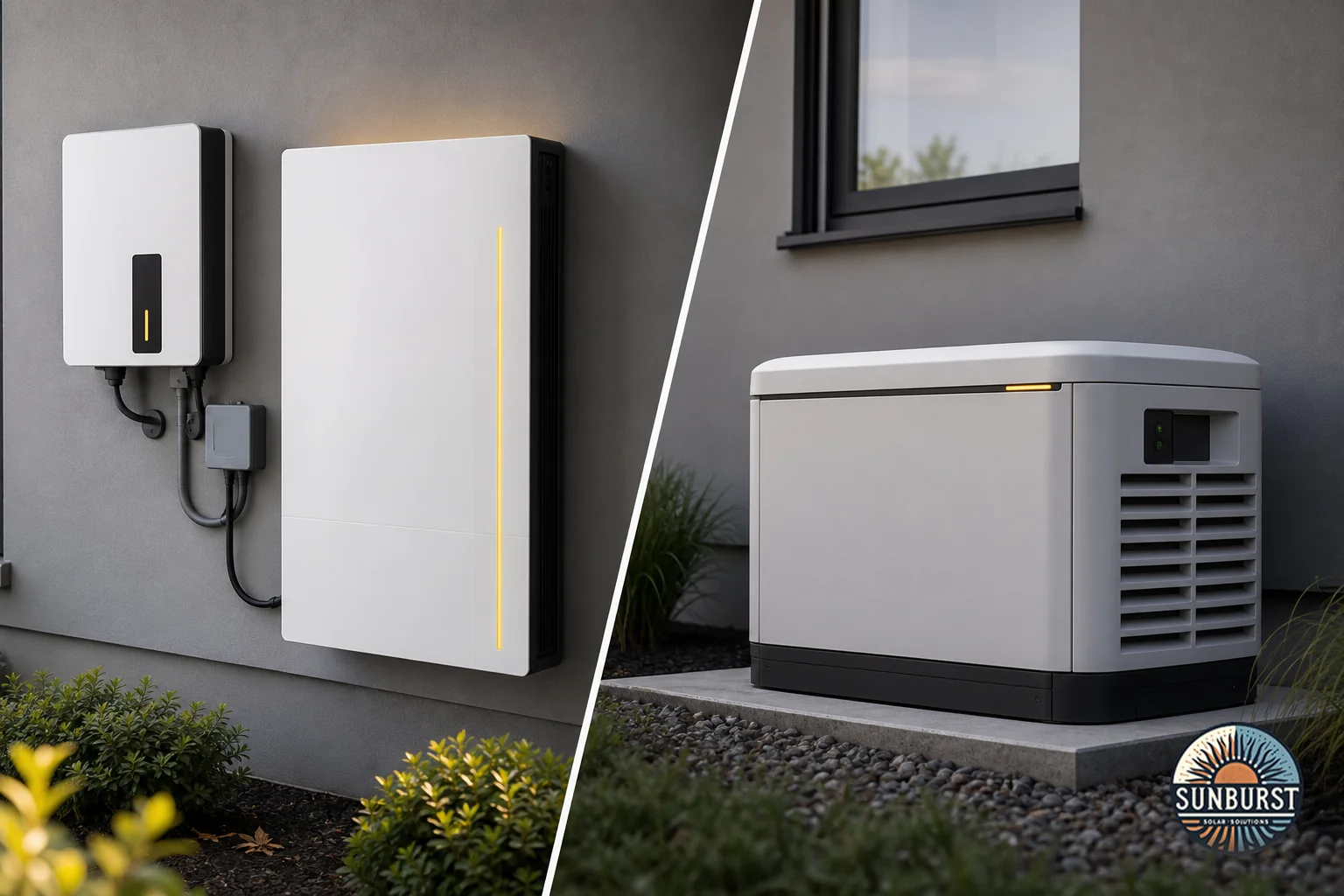
Batteries and generators solve overlapping but different problems. Batteries respond instantly and silently when the grid drops, but they hold a finite amount of energy unless recharged by solar or the grid. Generators can run indefinitely on fuel but need a physical fuel supply and produce noise and exhaust.
| Feature | Battery Storage | Standby Generator | Hybrid (Battery + Solar) |
|---|---|---|---|
| Switchover time | Instant, seamless | 10-30 seconds | Instant |
| Runtime limit | Fixed by kWh capacity | Limited by fuel supply | Extended by daytime sun |
| Noise | Silent | Audible while running | Silent |
| Maintenance | Minimal | Regular fuel/oil checks | Minimal |
| Best for | Short-to-medium outages, quiet operation | Extended outages, high total loads | Multi-day storms with sun recovery |
Many South Carolina homeowners land on a hybrid approach for exactly this reason. Our comparison of a solar battery vs generator for Hilton Head backup power walks through the trade-offs in more detail if you’re still deciding between the two.
Why Local Site Visits Beat Online Calculators
If you’ve searched for solar system installers near you, it’s usually because an online sizing tool gave a rough number that didn’t match your actual panel or your loads. A local site visit measures your real breaker labels, your roof’s solar potential, and your utility’s interconnection rules, something Santee Cooper territory homeowners in particular need to check before finalizing a system, as covered in our guide to Santee Cooper solar interconnection requirements. A generic web calculator can’t see any of that.
FAQ: Sizing a Home Battery Storage System
How many batteries do I need for backup power?
It depends on your essential load total and your outage duration goal. A household with modest critical loads (fridge, wifi, a few outlets) and a short-outage goal may need just one module. Add a well pump, sump pump, or multi-day storm resilience and you’ll likely need two or more stacked units.
Can one battery run my whole house?
Rarely, and it’s usually not the goal. Whole-home backup requires enough kWh and kW to cover every circuit, including heavy loads like central AC and electric dryers, which pushes most households toward a critical-loads subpanel instead.
Does battery size affect installation cost?
Yes, capacity is one of the biggest cost drivers. For a full cost breakdown by capacity tier, see our guide on what affects home battery storage cost.
Should I size for today’s loads or future additions like an EV charger?
If you’re planning to add an EV charger or expect future appliance upgrades, mention that during your load calculation so your installer can size the system with room to grow rather than needing a second project later. Our guide on EV charger installation considerations in Myrtle Beach covers how charging loads factor into panel capacity.
What questions should I ask before signing a contract for battery storage?
Ask exactly how the installer calculated your essential loads, what the inverter’s continuous and surge output ratings are, and whether the quoted capacity accounts for depth of discharge. Our checklist on what to ask before signing a solar contract covers these points alongside financing and warranty questions.
Get Your Loads Calculated by a Local Team
Guessing at battery size is how homeowners end up with a unit that can’t start the well pump, or one that cost thousands more than their actual backup needs required. A proper load calculation, done at your panel by someone who understands South Carolina’s outage patterns, is the difference between real peace of mind and an expensive surprise during the next storm. Sunburst Solar Solutions builds every battery recommendation around your specific circuits, your outage goals, and your roof’s solar potential, not a generic package. Get a free assessment and find out exactly how many kWh your home actually needs before you sign anything.