


Most homeowners need just one contractor for a straightforward solar install, as long as that company handles design, permitting, and installation in-house. The number climbs to two or three only when your roof needs replacing first or you’re adding battery storage through a separate vendor. Knowing how many contractors you need for a solar install before you sign anything is the single best way to avoid scheduling chaos and warranty disputes later.
Key Takeaways
- One contractor is often enough: A full-service solar company that also handles roofing, battery, and permitting can complete your project without you hiring anyone else.
- Three to four vendors is the risky default: Separate roofer, solar installer, electrician, and permit runner means four different schedules that rarely line up cleanly.
- Warranty disputes start at the seams: When a roof leak or wiring issue shows up after installation, separate contractors tend to point at each other instead of fixing it.
- Permitting is a process, not a person: In most South Carolina jurisdictions, your solar company should pull and manage permits as part of the installation contract, not as an extra hire.
- Ask before you sign: Confirm in writing whether roofing and battery work are done by the installer’s own crew or subcontracted out to a third party.
At a Glance: Contractor Needs by Project Type
| Project Type | Typical Contractors Needed | Common Pain Point | Single-Provider Solution |
|---|---|---|---|
| Solar panels only (roof in good shape) | 1 | Confirming roof condition before install | Installer inspects roof during site assessment |
| Solar + roof replacement | 1-2 (or 1 if roofing is in-house) | Roof leak blamed on the “other” contractor | One team, one warranty for roof and panels |
| Solar + battery storage | 1-2 (or 1 if battery is in-house) | Mismatched sizing between panels and battery | Battery sized as part of original system design |
| Solar + battery + roof + permitting | Up to 4 separately, or just 1 with a full-service provider | Scheduling conflicts, permit delays, split liability | Single point of contact for every phase |
| Solar + backup generator | 2 (solar company + generator specialist, unless bundled) | Two separate maintenance contacts | Some providers coordinate generator install alongside battery |
| HOA-governed community install | 1 (installer handles documentation) | Delayed approval from incomplete paperwork | Installer submits HOA package on your behalf |
So, How Many Contractors Do I Need for a Solar Install?
The honest answer depends on the condition of your roof and how much backup power you want. If your roof has 15 or more years of life left, a single licensed solar contractor can typically handle the entire job: site assessment, design, permitting, installation, and interconnection with your utility. That’s true whether you’re in Charleston, Columbia, Myrtle Beach, or Hilton Head Island.
Where the contractor count grows is when extra scope gets added. If your roof is aging or already showing wear, you’ll want roofing work folded into the same project, ideally by the same company. If you want battery storage for outages, that’s another layer of electrical work that should be scoped alongside the panels, not bolted on afterward by a different vendor. And if your home needs an electrical panel upgrade to support an EV charger or battery, that’s a third potential touchpoint.
The good news: none of this requires four separate hires if you choose a provider that already covers roofing, battery, and permitting under one roof (literally). Sunburst Solar Solutions structures projects this way specifically so homeowners across South Carolina aren’t left managing a patchwork of vendors on their own.

If you’re unsure what your roof and energy setup actually need, a quick way to get clarity is to check your solar potential before comparing contractor quotes. It gives you a baseline for what your system size and roof condition actually call for.
The Traditional Multi-Vendor Route (And Why It Gets Messy)
Before full-service solar companies became common, the standard path to going solar looked like this: hire a roofer to replace or repair the roof, hire a solar installer to mount the panels, hire an electrician for panel upgrades or battery wiring, and either hire a permit expediter or handle the paperwork yourself. That’s potentially four contracts, four insurance certificates, and four different schedules to track.
Here’s where it tends to break down. The roofer finishes on a Tuesday. The solar crew was supposed to start Wednesday but got delayed by a permit hiccup, so your roof sits exposed to South Carolina’s summer storms for an extra week. Or the reverse happens: panels go up first, and six months later you discover a leak. The roofer says the leak is from the mounting hardware. The solar installer says the roof deck was already compromised before they touched it. Neither one owns the fix, and you’re the one stuck in the middle.
When something goes wrong at the seam between two contractors, homeowners often discover that no single warranty covers the combined problem, even though each contractor’s individual work was covered.
This isn’t a rare scenario. It’s common enough that it shows up in red flags to watch for when choosing a solar installer, because vague answers about who’s responsible for what are one of the clearest warning signs of a disorganized company.
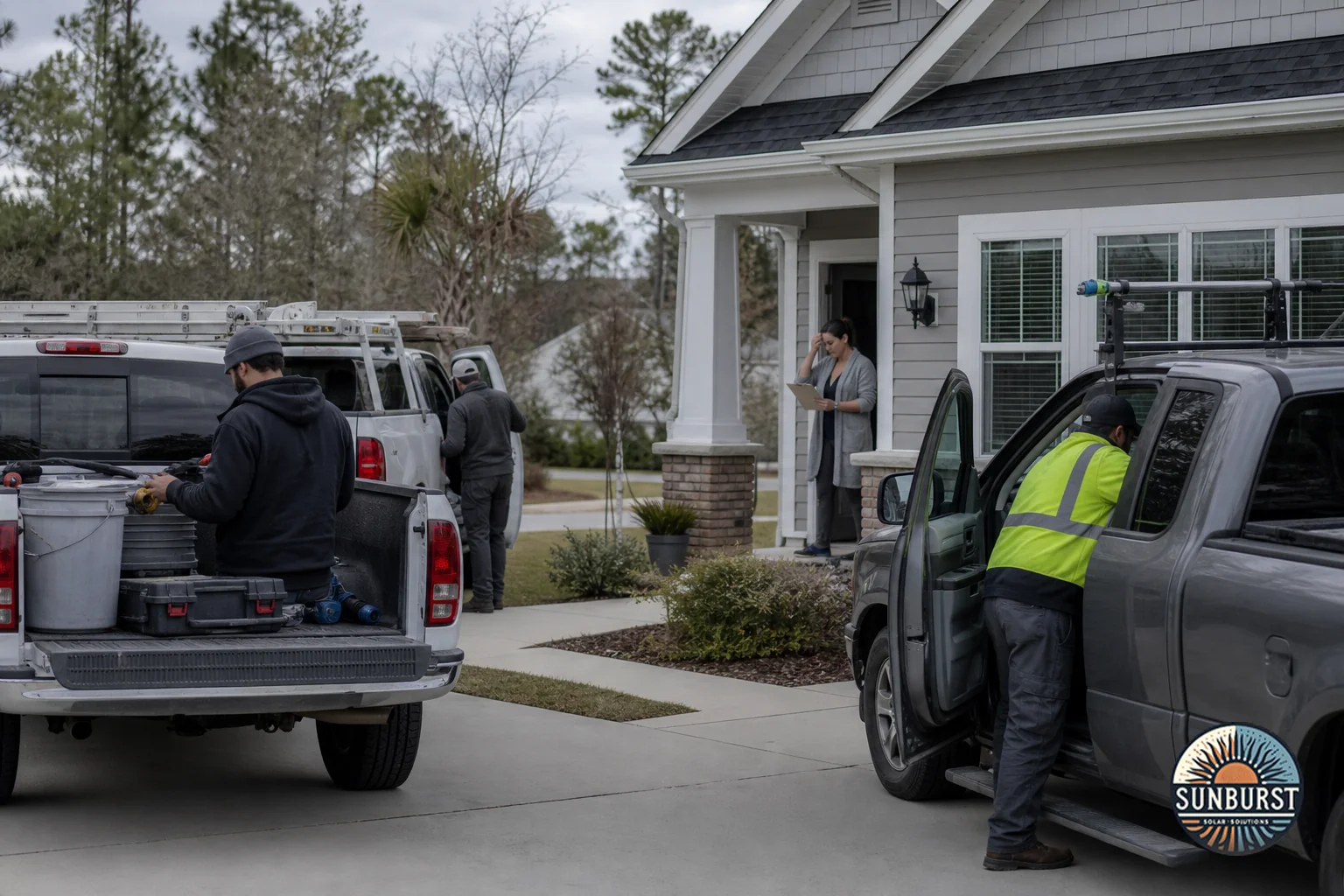
Beyond the finger-pointing risk, there’s also a real cost in your time. Collecting and comparing bids from four separate trades, verifying each one’s licensing and insurance, and coordinating four different start dates is a part-time job most homeowners didn’t sign up for. If you’ve already read through questions to ask before hiring a solar company, you’ve probably noticed how many of those questions are really about accountability: who’s responsible if something breaks, and who answers the phone when it does.
What a Single-Provider (Full-Service) Approach Looks Like
A full-service solar company folds every phase of the project under one roof: design, HOA documentation, permitting, roofing (through an in-house crew or a tightly managed roofing partnership), solar installation, battery integration, and ongoing monitoring. You sign one contract. You get one warranty document covering the roof penetration, the racking, the panels, and the workmanship. You have one phone number to call if anything needs attention five years down the road.
Sunburst Solar Solutions built its process around this model for a reason. Instead of handing you off to a roofing subcontractor and hoping the two teams communicate well, the roofing partnership services are coordinated directly by the same project team managing your solar timeline. That means the roofer and the solar crew are working from the same schedule, not competing for calendar space.
This matters most in two specific situations:
- Roof replacement before solar: If an inspection shows your roof won’t outlast your panels’ 25+ year lifespan, replacing it first under the same provider avoids a second round of bidding and a second warranty to track. Our detailed breakdown of whether your roof needs replacing before solar panels walks through how that assessment works.
- Battery storage sizing: A battery sized without knowing your actual solar production numbers is a guessing game. When the same team designs both, the battery capacity matches your real usage and backup needs instead of a generic package.
The workmanship warranty, manufacturer warranties on the panels and battery, and third-party insurance protection all sit under one umbrella instead of three separate documents with three separate exclusions.
When You Might Still Need a Separate Contractor
A single-provider approach covers most residential projects, but it isn’t a universal fix for every home. There are a handful of situations where an additional, separate contractor still makes sense:
- Structural roof repairs: If an inspection uncovers rotted decking, foundation issues, or storm damage beyond a standard reroof, that’s often a job for a structural specialist before any solar work begins.
- Whole-home electrical rewiring: Older homes with outdated panels sometimes need broader electrical work unrelated to solar, such as replacing old aluminum wiring throughout the house.
- Standalone backup generator installs: Some homeowners, especially on Hilton Head Island where storm outages are a real planning concern, want both a battery and a fuel-based generator. Comparing solar battery vs. generator options for Hilton Head is worth doing before deciding whether you need one system or both.
- HOA-specific landscaping or fencing changes: If your HOA approval requires screening for ground-mounted equipment, a landscaper may be a separate line item outside your solar contract.
Even in these cases, a good full-service provider will tell you upfront when something is outside their scope instead of quietly subcontracting it without your knowledge.
Questions to Ask Before You Hire (So You Know Exactly Who Does What)
The clearest way to find out how many contractors your specific project actually needs is to ask direct questions during your consultation. Bring this list with you:
- Is roofing work done by your own crew, or is it subcontracted? If it’s subcontracted, ask who carries the warranty on the roof penetration points.
- Who pulls the permits, and how long does approval typically take? In most South Carolina counties, permitting adds real time to your project. Understanding how long solar permitting approval takes helps you set realistic expectations for your install date.
- What happens if there’s a roof leak after solar goes in? Get a written answer about who is liable, not a verbal reassurance.
- Is battery sizing part of the same design process as the solar system? If a battery is quoted separately without reference to your actual production numbers, ask why.
- Can I see one combined warranty document? If the answer involves flipping between three separate PDFs from three separate companies, that’s worth noting.
- Who handles HOA paperwork? If you live in a managed community, this alone can determine your timeline. Our guide on HOA solar approval in Columbia, SC shows what a well-managed approval process looks like.

Write down the answers. A company that answers all six clearly and in writing is signaling a coordinated process. A company that gets vague about any of them is a sign you may end up managing more contractors than you expected.
How Permitting Fits Into the Contractor Count
Permitting confuses a lot of homeowners because it feels like it should require its own specialist. In practice, it’s a process your solar company manages, not typically a separate contractor you hire. Your installer submits engineering plans, electrical diagrams, and structural details to your local building department and utility, then coordinates inspections once installation is complete.
Where this gets complicated is when roofing, solar, and battery work come from three different companies. Each one may need to submit its own portion of the permit package, and if one company’s paperwork is incomplete or delayed, the whole timeline stalls, even though the other two contractors are ready to move. This is one of the quieter reasons multi-vendor projects run long.
A single provider managing the entire permit package, from the initial site plan to the final utility interconnection, tends to move faster simply because there’s no handoff between separate companies’ paperwork. If you want a deeper look at typical timelines across South Carolina jurisdictions, see our post on how long solar permitting approval actually takes.
Sunburst Solar Solutions: One Team for Your Whole Project
Homeowners searching for “Sunburst Solar Solutions” are usually trying to confirm one thing: does this company actually handle the whole job, or will I still end up juggling separate vendors? The short answer is that Sunburst Solar Solutions was built specifically to be a single point of contact across Charleston, Columbia, Myrtle Beach, Hilton Head Island, and the surrounding South Carolina coast. Site assessment, custom system design, roofing partnership services, battery integration, HOA documentation, permitting, installation, and ongoing performance monitoring all run through the same project team.
That coordinated structure is also why comparisons matter. If you’re weighing a regional, relationship-driven installer against a large national brand, our post on local vs. national solar installers in Charleston, SC covers how service models differ, including how many hands typically touch your project with each approach.
Going solar shouldn’t mean becoming your own general contractor. The fewer seams in your project, the fewer places for scheduling gaps, warranty confusion, or unanswered calls to creep in. When one team owns the roof, the panels, the battery, and the permit, you get one calendar, one warranty, and one number to call.
If you’re ready to find out exactly what your home needs, start with a free check of your solar potential to see your system size, roof considerations, and battery options in one place. From there, you can book an appointment for a full site assessment and get a straight answer about how many contractors your specific project actually needs, likely just one. You can also join us to stay updated on South Carolina solar incentives, permitting changes, and financing options as they evolve.