
A Mt. Pleasant homeowner gets two solar quotes on the same afternoon: one from a national brand’s online calculator, one from a Charleston-based crew that already knows her HOA’s architectural review board by name. The panels, the warranty paperwork, and the tax credit math look almost identical. What’s different is who shows up when something needs fixing five years from now. That’s the real question behind local solar installer vs national company charleston comparisons, and it matters more than most sales pitches let on.
Key Takeaways
- HOA approval moves faster with local knowledge: Charleston-area installers who’ve already submitted paperwork to specific neighborhood boards tend to clear architectural review in days instead of weeks.
- Warranty response depends on who’s still around: National companies sometimes exit markets or reassign territories, leaving homeowners to track down a new point of contact for service.
- Permitting speed tracks with familiarity, not company size: Installers who submit permits weekly to Charleston County or the City of Charleston move through review faster than centralized, out-of-state permitting teams.
- Install crews aren’t always employees: Many national providers subcontract the physical installation, which can affect accountability if something goes wrong on your roof.
- Total cost of ownership beats sticker price: A lower online quote can cost more over 25 years if service delays or subcontractor turnover slow down repairs and monitoring support.
Local vs National Solar Installer in Charleston: At a Glance
| Factor | Local Installer (e.g., Sunburst Solar Solutions) | National Company |
|---|---|---|
| HOA approval handling | Direct relationships with area architectural review boards; tailored packets | Generic documentation templates, often needs revision for local rules |
| Permitting speed (Charleston area) | Familiar with City of Charleston, Charleston County, Mt. Pleasant checklists | Centralized permitting teams less familiar with local jurisdiction quirks |
| Install crew | Typically in-house, background-checked technicians | Often subcontracted regional crews that can change year to year |
| Warranty follow-through | Local office and techs available for service calls | Ticket-based support; response can depend on regional contractor availability |
| Pricing structure | Personalized quotes based on site visit and roof specifics | Fixed online pricing, fast quotes, less site-specific customization upfront |
| Long-term availability | Physical presence in South Carolina, direct phone line to techs | Depends on whether the company maintains service in your specific market |
| Financing options | Cash, loan, lease/PPA with local underwriting conversations | Large-scale financing partners, often less flexible negotiation |
What “Local” and “National” Actually Mean in Solar
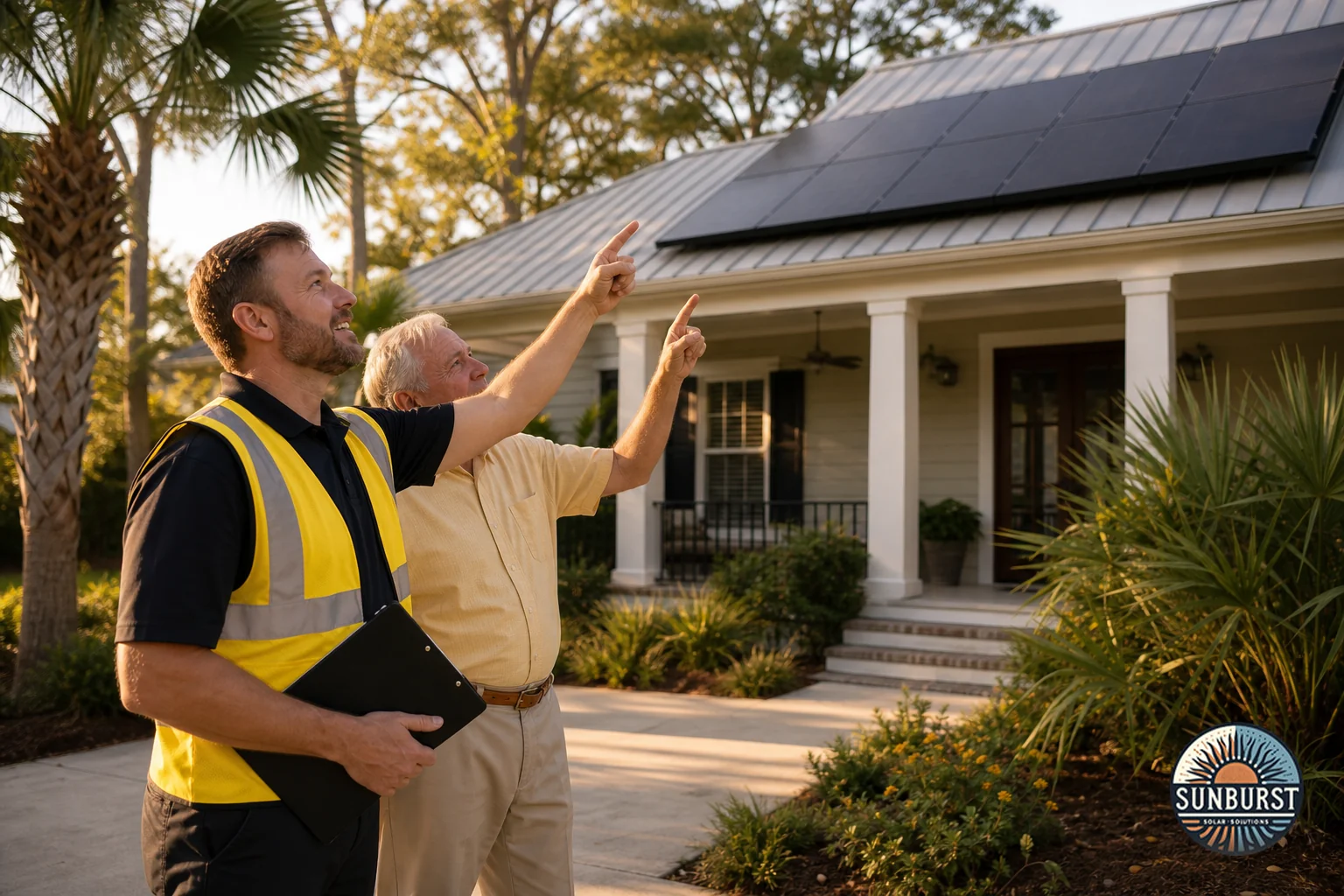
The terms get thrown around loosely, so it helps to define them before comparing anything. A local solar installer is typically headquartered in the state or region it serves, employs its own installation crews, and operates out of a physical office you could actually drive to. Sunburst Solar Solutions, based in the Charleston area, works this way: consultations, system design, HOA paperwork, and installation are handled by people who live and work in South Carolina.
A national company operates across dozens of states, often through a mix of company-owned branches and independent dealer or subcontractor networks. Companies like Sunrun and Freedom Forever fall into this category, along with manufacturer-backed programs like Tesla Energy’s solar division. These companies bring real advantages: bulk purchasing power, standardized online quoting, and brand recognition. None of that is disqualifying. But scale changes how a company handles the parts of a solar project that require someone showing up in person, on your street, more than once.
Understanding this distinction sets up every comparison that follows, from HOA approval to who answers the phone when your inverter throws an error code in year eight.
HOA Approval: Why Local Knowledge Matters
Charleston has no shortage of HOA-governed neighborhoods, from Daniel Island to Carolina Park to older planned communities around Mt. Pleasant and James Island. Each one runs its own architectural review process, with its own preferences on panel visibility, roof-facing placement, and equipment screening. There’s no single statewide HOA solar template that works everywhere.
South Carolina’s solar access law limits how much an HOA can restrict solar installations outright, but it doesn’t remove the approval step itself. Boards can still regulate placement and appearance within reason. This is where local familiarity pays off. An installer who has already submitted packets to a specific Charleston-area HOA board knows what that board wants to see, what gets flagged, and how long review typically takes.
National companies tend to rely on a standardized HOA packet built for a broad customer base across multiple states. It’s not that the packet is wrong, it’s that it’s generic, and boards sometimes send it back asking for more specifics like exact panel layout diagrams or sightline studies. That back-and-forth adds weeks. For a deeper look at how one South Carolina market handles this, see HOA Solar Approval in Columbia, SC: How It Works, which walks through the review process homeowners can expect.
Permitting Speed: City of Charleston, Charleston County, and Beyond
Permitting is a separate hurdle from HOA approval, and it runs through a government office rather than a private board. Charleston homeowners might be dealing with the City of Charleston, Charleston County, Mt. Pleasant, or one of several other municipal permitting departments, each with its own submission portal, inspection schedule, and documentation standards.
Installers who submit permits in the same offices every week build a working familiarity with reviewers. They know which forms get bounced back for missing signatures, which inspectors want conduit run a certain way, and roughly how long a typical residential solar permit takes to clear in that specific jurisdiction. That institutional knowledge shaves real time off the process.
National companies often route permitting through centralized software platforms designed to handle submissions across many states at once. Efficient in theory, but the system isn’t always tuned to the quirks of a specific county office. If you want a fuller breakdown of typical timelines, Solar Installation in Charleston, SC: What to Expect covers what the process looks like from consultation through final inspection.
Warranty Support: What Happens When Something Breaks in Year 7
Every reputable solar company will show you a warranty summary during the sales process. The number that gets highlighted, usually 25 years on panels, sounds reassuring. But a warranty is only as good as the company’s ability to act on it years down the road, and that’s where local versus national starts to matter in a very practical way.
There are actually three separate warranties layered on top of each other: the manufacturer’s product and performance warranty on the panels and inverter, the installer’s workmanship warranty covering the physical installation, and in some cases third-party insurance backing the workmanship guarantee. If a national company restructures, sells a regional territory, or exits a state, the manufacturer warranty may still technically apply, but the workmanship warranty can become harder to enforce if the original installing entity no longer operates locally.
A regionally based company with a physical office and its own service technicians can typically send someone out directly, without routing the request through a national call center or a rotating cast of subcontractors. Sunburst Solar Solutions backs its installations with a 10-year workmanship warranty plus third-party insurance protection, specifically because equipment warranties alone don’t guarantee a fast, local response when something goes wrong. If you’re comparing coverage across companies, how to compare solar warranty coverage style guidance is worth reviewing before you sign anything, since fine print varies more than most homeowners expect.
Long-Term Service and Monitoring: Who Answers the Phone in 10 Years?
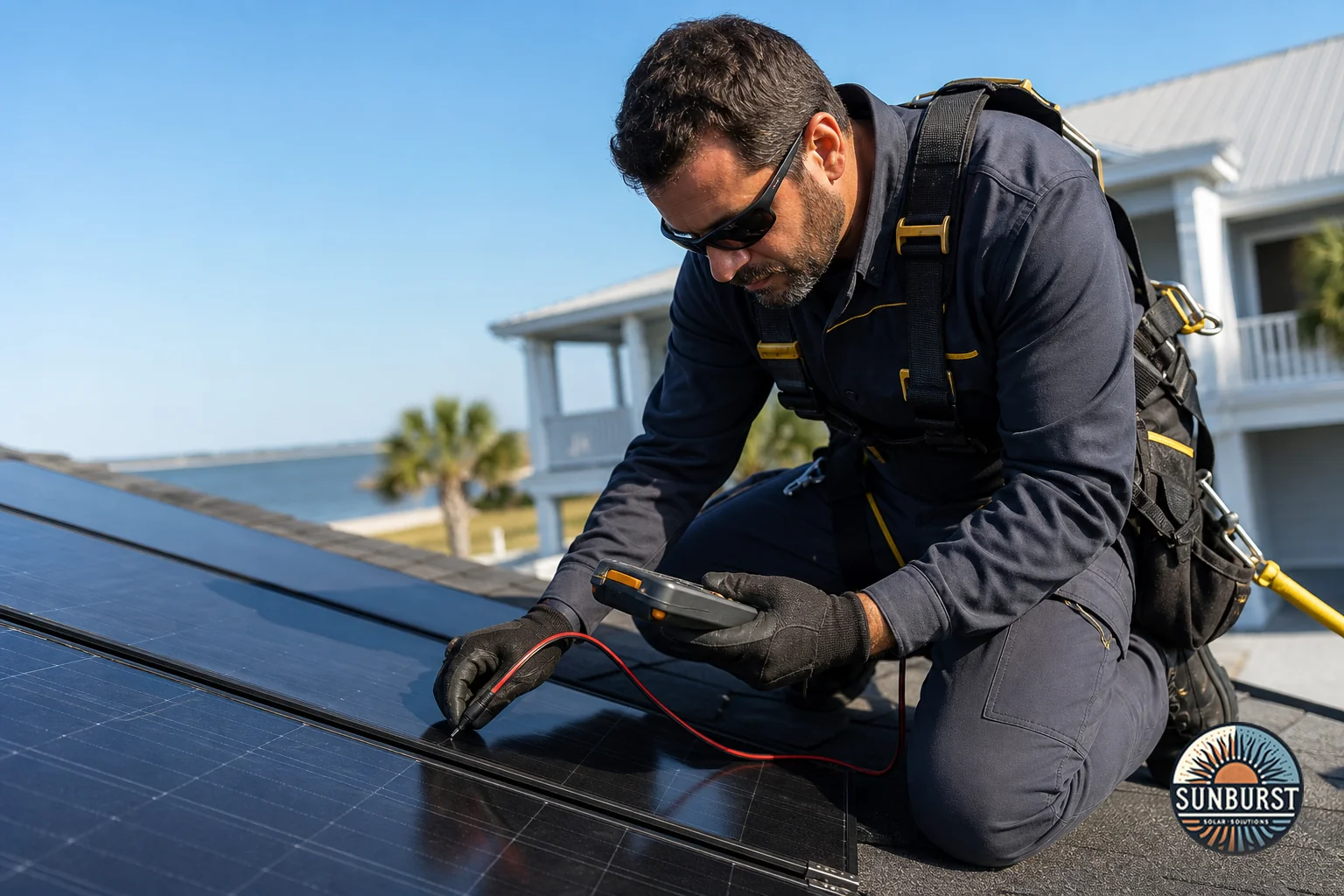
Solar systems are built to last 20 to 25 years, and over that lifespan, they need occasional attention. An inverter might need replacing around year 10 to 15. A monitoring app might stop reporting data correctly. A tree that’s grown taller might start shading part of the array. None of these are emergencies, but they all require a company that’s still reachable, still local, and still willing to send a technician.
This is worth asking directly in any sales conversation, whether you’re talking to a regional company or a national one: will the same company, or even the same crew, still be servicing this system a decade from now? National companies that operate at scale sometimes handle service through ticket-based systems, where a request gets routed to whichever contractor currently holds that territory. That can mean a different technician, a different process, and a longer wait each time.
Ongoing performance monitoring is part of this picture too. A monitoring app is only useful if there’s a real person on the other end who can interpret a strange reading and dispatch help. For homeowners in the Charleston area, local installation and service expectations are worth reviewing alongside any monitoring platform demo a company shows you during the sales pitch.
Pricing and Financing: Where National Companies Sometimes Win
It wouldn’t be a fair comparison without acknowledging where national companies have a genuine edge. Bulk purchasing power on panels, inverters, and batteries can translate into competitive fixed pricing, and some national providers offer instant online quotes without a home visit, which appeals to homeowners who want a fast, low-friction first step.
Local companies typically take a more consultative approach: a site visit, a custom system design based on your specific roof pitch and shading, and a more personalized financing conversation covering cash purchase, loan, or lease/PPA options. That process takes a bit longer upfront but often results in a system sized more precisely for your actual usage, not a generic package.
New 2026 homeowner solar or battery installations do not qualify for the expired federal Residential Clean Energy Credit. South Carolina incentives are a separate calculation with their own eligibility, annual limits and tax-liability requirements. Confirm the actual project with a qualified tax professional; do not assume combined federal/state credits cut a new purchase price in half. See current IRS Section 25D guidance.
Questions to Ask Any Solar Company Before You Sign
Whether you’re leaning local or national, the same set of questions should be part of every consultation. The answers reveal more about long-term reliability than any brochure will.
- Who physically installs the panels? Ask whether it’s an in-house crew or a subcontractor, and how long that crew has worked with the company.
- How many separate contractors are involved? Solar, roofing, and electrical panel upgrades sometimes require coordinating multiple trades. Ask who manages that coordination so you’re not the one juggling three phone numbers.
- What’s the typical HOA and permitting timeline for your specific city? A vague answer like “it varies” is less useful than a company that can point to recent projects in your exact neighborhood.
- How are warranty claims handled, and who do you call? Get a direct answer on whether it’s a local technician or a national support queue.
- Will this company still be servicing your system in 10 years? No one can promise the future, but you can ask how long they’ve operated in the Charleston market and whether they’ve had to transfer accounts before.
For a longer list of vetting questions, How to Choose a Solar Installer: 7 Red Flags to Avoid covers warning signs worth watching for during the sales process, and it pairs well with this comparison when you’re narrowing down candidates.
How to Decide: Local Installer vs National Company for Your Charleston Home
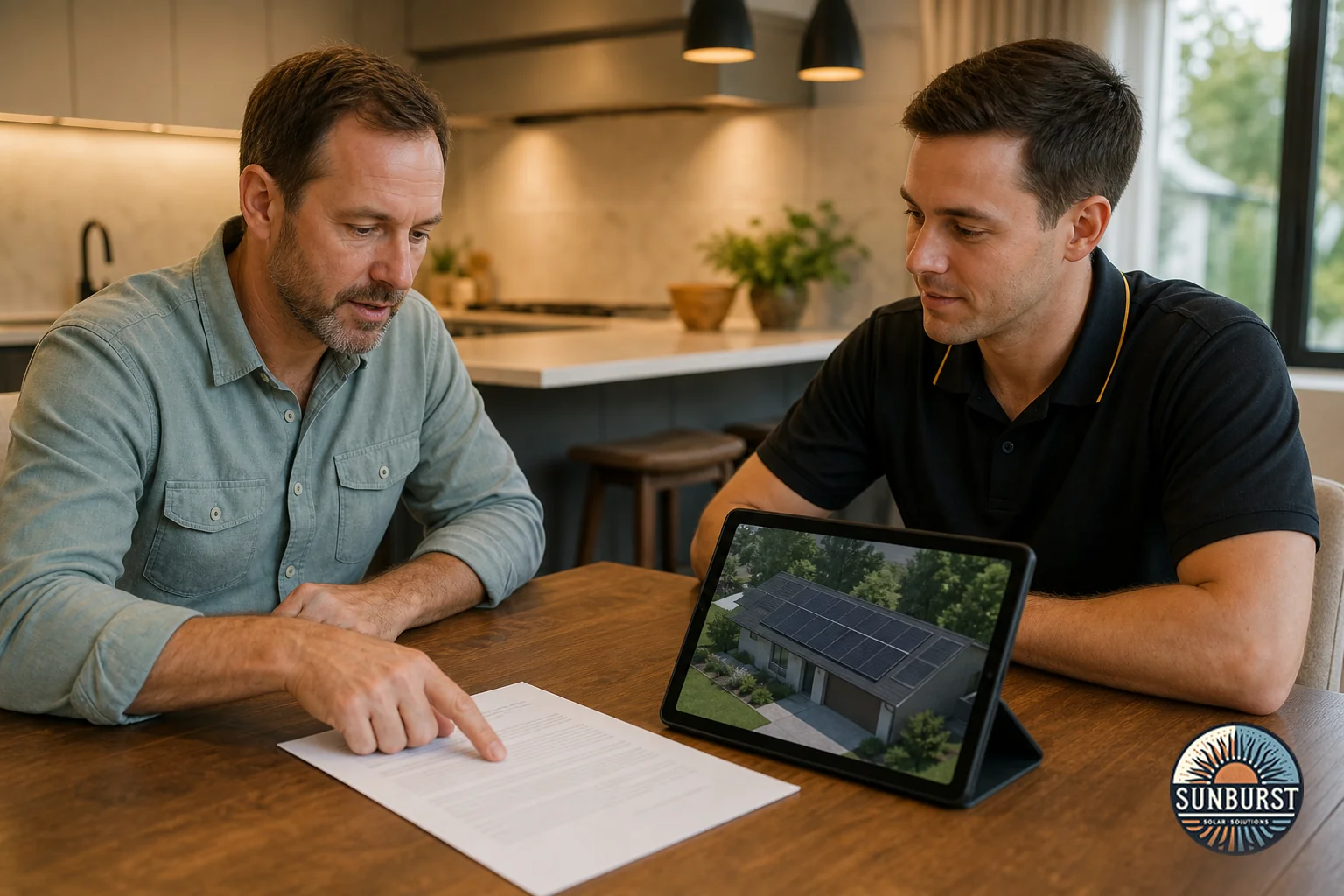
There’s no universally correct answer here, but there is a useful framework. If your top priority is the fastest possible online quote and you’re comfortable with ticket-based service down the road, a national company might fit. If you live in an HOA-governed neighborhood, want a single point of contact who knows Charleston’s permitting offices by name, and expect to call the same company for maintenance a decade from now, a regionally based installer tends to serve that priority better.
Roof condition matters here too. If your roof needs work before installation, coordinating that with a solar-savvy local partner avoids the headache of managing separate roofing and solar contractors on your own. See Does Your Roof Need Replacing Before Solar Panels? for guidance on that decision before your install date gets scheduled.
Sunburst Solar Solutions was built around this exact set of priorities: a concierge-style process that handles HOA documentation, permitting, financing conversations, and long-term monitoring under one local roof, backed by Tier 1 black-on-black panels and a workmanship warranty with third-party insurance behind it. For homeowners weighing a local solar installer vs national company charleston decision, that combination of local accountability and manufacturer-grade equipment is worth putting side by side with any national quote you’ve received.
Frequently Asked Questions
Is a local solar installer cheaper than a national company in Charleston?
Not necessarily on the initial quote. National companies sometimes offer competitive fixed online pricing due to purchasing scale. Local installers may price closer to project specifics after a site visit. The bigger cost difference usually shows up over time, in how quickly warranty issues get resolved and whether service delays end up costing you lost production.
Do national solar companies offer the same warranties as local installers?
Manufacturer warranties on panels and inverters are generally comparable regardless of installer size, since those come from the equipment maker. Workmanship warranties differ more, and enforcement depends on whether the original installing company still operates in your area. Always ask specifically how a workmanship claim gets filed and serviced years after installation.
Can I switch installers if a national company leaves my area?
Manufacturer warranties typically transfer with the equipment regardless of who installed it, but workmanship warranties tied to the original installer can become harder to enforce if that company no longer services your region. Another licensed installer can usually take over monitoring and maintenance, though you may lose the original workmanship coverage in the process.
What is Sunburst Solar Solutions and how does it compare to companies like Sunrun or Tesla Energy?
Sunburst Solar Solutions is a regional, Charleston-area solar installer offering custom system design, HOA approval assistance, financing options, and ongoing maintenance with a local team. Compared to national providers like Sunrun, Tesla Energy, or Freedom Forever, Sunburst emphasizes a more personalized consultation process and direct local service rather than centralized, multi-state operations. For background on typical South Carolina rebates and credits either type of installer should help you claim, see Solar Tax Credits & Incentives in 2026: What Qualifies?
If you’re weighing a local solar installer against a national company for your Charleston home, the fastest way to get a clear answer is to compare a real, site-specific quote against whatever online estimate you’ve already received. Check your solar potential to see what a custom system could look like on your roof, then book an appointment with a local Sunburst Solar Solutions team member to walk through HOA requirements, permitting timelines, and warranty coverage specific to your neighborhood. Homeowners who’d rather stay in the loop on solar incentives and local installation news first can also join us for updates before making a final decision.