
A 200,000-square-foot warehouse in North Charleston and a two-story dental office in Mount Pleasant both qualify for commercial solar installation in Charleston, SC, but they’ll almost never use the same equipment, financing, or permitting path. Commercial solar runs on three-phase power, larger interconnection studies, and depreciation rules that don’t exist for homeowners. Understanding those differences up front is what keeps a business project on schedule instead of stalled for months.
Key Takeaways
Commercial solar tax benefits require a project-specific review. Eligibility, placed-in-service and construction timing, ownership, applicable credit multipliers, labor requirements and other restrictions determine whether an incentive can be claimed. Neither a universal 30% credit nor depreciation benefits should be promised from a generic quote. Review the IRS Form 3468 instructions with the business’s tax adviser and compare the commercial solar tax guide before subtracting a benefit from the price.
Commercial Solar at a Glance
| Property Type | Typical System Size | Roof/Site Consideration | Common Financing |
|---|---|---|---|
| Small office | 20-75 kW | Pitched or low-slope roof, daytime load match | Cash, commercial loan |
| Warehouse/industrial | 100-500+ kW | Large flat roof, structural review required | Loan, PPA |
| Retail center | 50-250 kW | Rooftop or parking carport canopy | Lease, PPA |
| Multifamily property | 75-300 kW | Shared vs. individually metered units | PPA, owner-financed |
| Typical timeline | 3-6 months, proposal to permission to operate | ||
| Utility territories | Dominion Energy SC, Santee Cooper, Berkeley Electric Cooperative | ||
| Federal tax treatment | Business eligibility and project requirements must be verified; no automatic credit | Business eligibility and project requirements must be verified; no automatic credit | Business eligibility and project requirements must be verified; no automatic credit |
1. Understand How Commercial Solar Differs From Residential
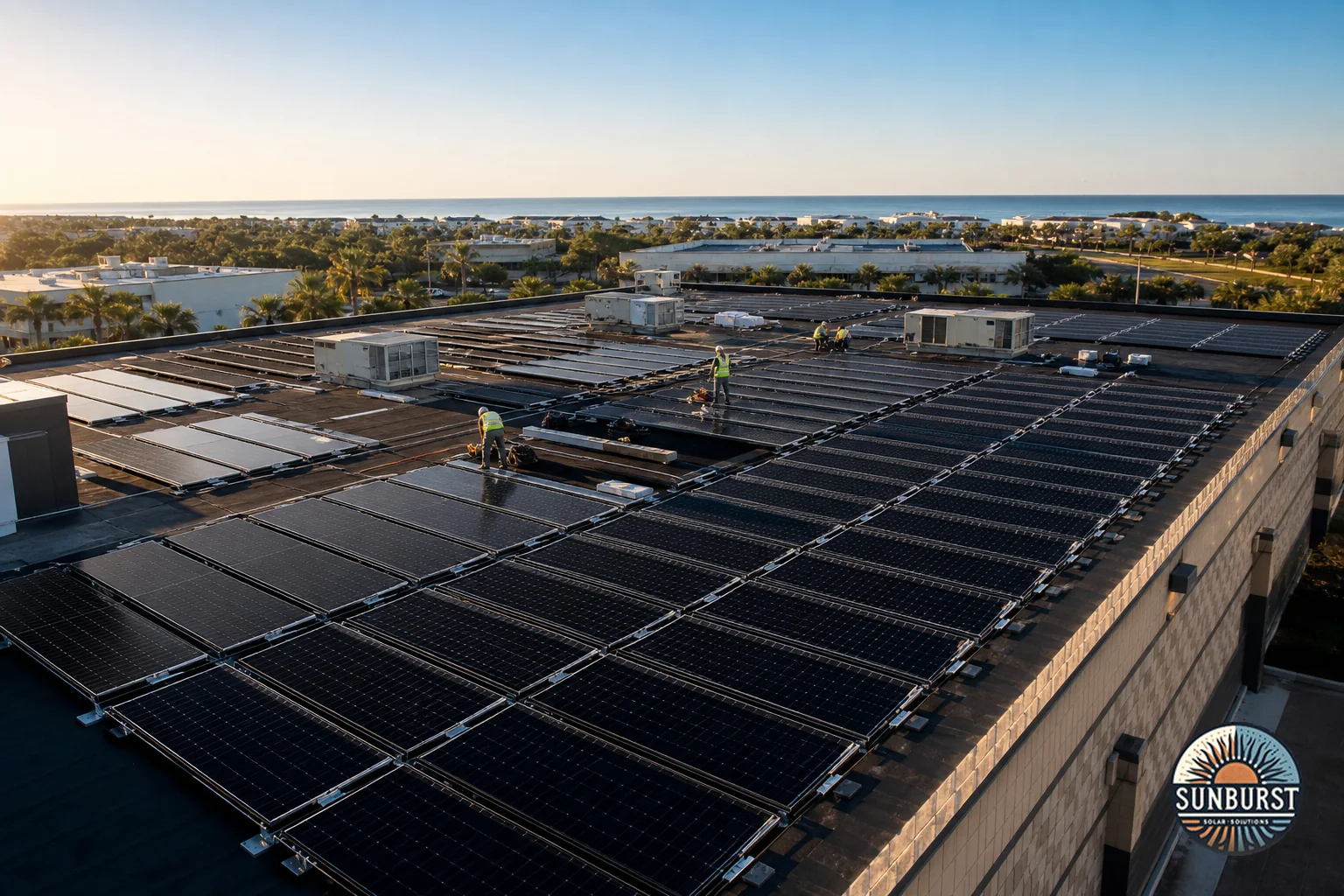
Homeowners usually deal with single-phase electrical service and a system sized to offset one utility bill built around monthly kWh usage. Commercial buildings are a different animal. Most run three-phase power, which needs specific inverters, transformers, and switchgear that a residential-only installer may not stock or have experience wiring correctly.
Commercial system sizing also looks at demand charges, not just total energy used. A restaurant that spikes to a high kW draw for two hours during lunch rush pays a demand charge on top of its energy charge, and that number can make up a third of the bill or more. A well-designed commercial solar system, sometimes paired with battery storage, can shave those peaks and cut a cost that residential customers rarely see on their bills at all.
Roof structure adds another layer. Many commercial buildings have flat or low-slope roofs covered in membrane roofing (TPO, EPDM) rather than shingles. That means a structural engineer typically needs to confirm the roof can handle the added weight, and racking has to be selected to avoid unnecessary roof penetrations. If your building’s roof is aging, it’s worth reading our related piece on whether your roof needs replacing before solar panels go up, since the same logic applies to commercial membrane roofs nearing the end of their service life.
Commercial solar tax benefits require a project-specific review. Eligibility, placed-in-service and construction timing, ownership, applicable credit multipliers, labor requirements and other restrictions determine whether an incentive can be claimed. Neither a universal 30% credit nor depreciation benefits should be promised from a generic quote. Review the IRS Form 3468 instructions with the business’s tax adviser and compare the commercial solar tax guide before subtracting a benefit from the price.
2. Start With a Site Assessment and Energy Audit
Before anyone talks about panel count, a legitimate commercial solar company should ask for 12 months of utility bills. That history shows seasonal usage swings, existing demand charges, and rate structure, all of which shape how big the system needs to be and whether battery storage makes financial sense.
The physical site assessment covers several things at once:
- Roof condition and remaining lifespan: A 20-year-old membrane roof with 5 years left isn’t a good candidate for a 25-year solar array without a conversation about replacement first.
- Structural load capacity: An engineer confirms the roof deck and supporting structure can carry the extra weight of panels, racking, and, if applicable, snow or wind loads under South Carolina building code.
- Available space: Warehouses often have enough flat roof area to go well beyond what’s needed to offset current usage, opening the door to EV fleet charging or future expansion.
- Shading: In dense parts of downtown Charleston or Mount Pleasant, neighboring buildings and mature tree canopy can shade part of a roof during peak sun hours, which a proper shading study catches before installation, not after.
This is also the point where it’s worth asking how many separate companies will be involved. Commercial projects sometimes bundle in roofing, electrical panel upgrades, and battery installation, and it’s fair to ask upfront whether one team manages all of it or whether you’ll be coordinating between three vendors. We cover this in more detail in Solar, Roofing & Battery: Do You Need Multiple Contractors?.
3. Navigate Permitting and Utility Interconnection Locally
Commercial solar permitting in the Charleston area runs through the local building department, whether that’s the City of Charleston, Charleston County, Berkeley County, or Dorchester County, depending on where the property sits. Larger commercial systems often trigger a more detailed plan review than a residential permit, including structural calculations, electrical single-line diagrams, and fire code setbacks for rooftop access.
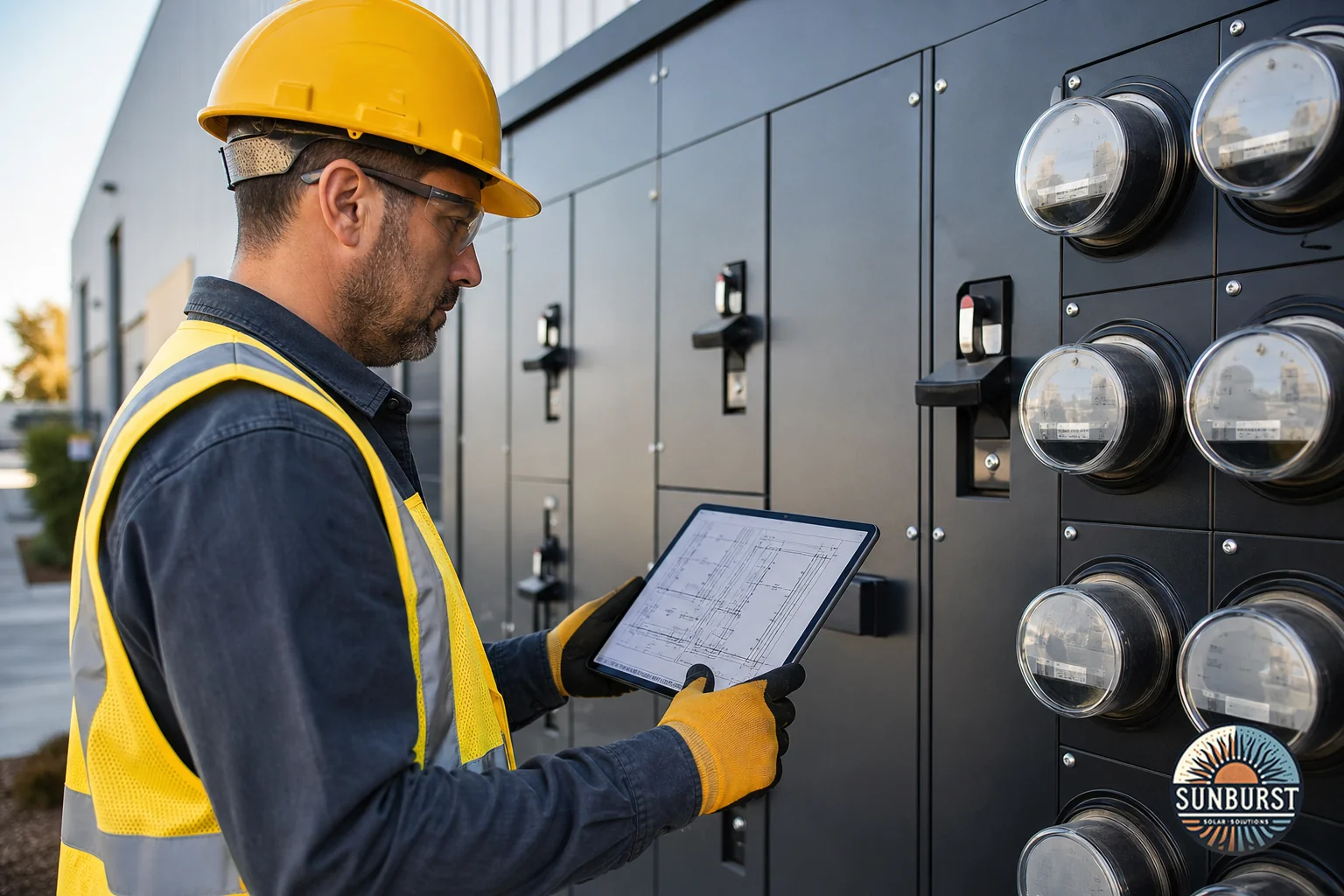
Utility interconnection is where commercial timelines really diverge from residential ones. Charleston-area businesses fall under a few different utility territories:
- Dominion Energy South Carolina requires an interconnection application, and systems above certain kW thresholds trigger an engineering review or supplemental study before approval.
- Santee Cooper and the electric cooperatives it supplies, including Berkeley Electric Cooperative, run their own commercial interconnection processes with separate net metering or net billing terms.
- Systems sized for larger warehouses or multifamily properties sometimes exceed the threshold for a simplified review, meaning the utility has to study impacts on the surrounding grid before granting permission to operate.
Realistically, plan for permitting and interconnection combined to take anywhere from 6 to 16 weeks on top of design and equipment lead time, longer if your system size requires a full utility study. For a broader look at how approval timing works across residential and commercial projects, see Solar Installation in Charleston, SC: What to Expect, and if you want the general permitting timeline breakdown, our guide on how long solar permitting approval takes covers the step-by-step process in more depth.
The single biggest driver of commercial solar delays isn’t the installation itself, it’s waiting on permission to operate from the utility after the physical work is already done.
4. Choose the Right System for Your Property Type
Not every commercial building should get the same solar strategy. The property type changes both the engineering and the financial case.
Offices
Office buildings tend to have predictable daytime usage that lines up well with solar production hours. A rooftop array sized to cover HVAC, lighting, and equipment loads during business hours is usually the sweet spot, and many offices in the Charleston area can offset a meaningful share of their bill without needing a massive footprint.
Warehouses and Industrial Buildings
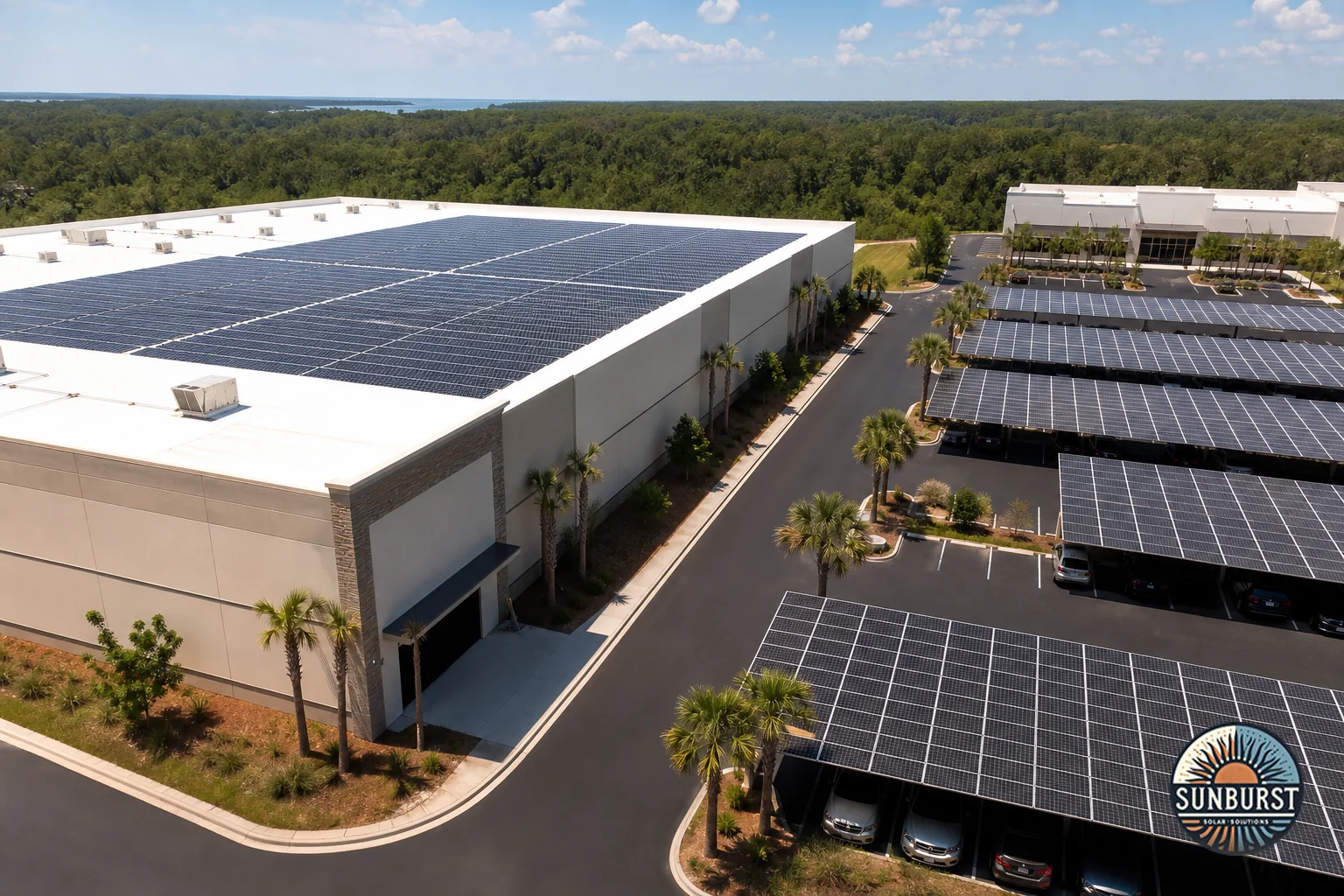
Warehouses often have the largest available roof area relative to their energy use, which means self-consumption isn’t the only goal, capacity for growth is. Cold storage, refrigeration, and conveyor equipment can also create steady baseline loads that solar plus battery storage handles well. Some warehouse operators use the extra roof capacity to support fleet EV charging as delivery vehicles electrify.
Retail Properties
Retail centers sometimes have less usable roof space relative to their footprint, especially strip malls with HVAC units and rooftop equipment already in place. Solar carports over parking areas are a common workaround, and they double as a visible sustainability signal for customers pulling into the lot.
Multifamily Properties
Apartment complexes and condo buildings raise a different question: does the system serve common-area loads only, or does it need to be split across individually metered units? Multifamily solar often uses a PPA or owner-financed structure so the property owner captures the tax benefits while tenants see stable common-area costs. If the property has an HOA or condo association involved in exterior approvals, our piece on HOA solar approval in Columbia, SC explains how those review boards typically evaluate solar requests, a process that runs similarly for commercial-adjacent multifamily buildings.
5. Decide How to Pay: Cash, Loan, Lease, or PPA
How you pay for a commercial solar system changes who benefits from the incentives, and it’s worth working through the math before signing anything.
Commercial solar tax benefits require a project-specific review. Eligibility, placed-in-service and construction timing, ownership, applicable credit multipliers, labor requirements and other restrictions determine whether an incentive can be claimed. Neither a universal 30% credit nor depreciation benefits should be promised from a generic quote. Review the IRS Form 3468 instructions with the business’s tax adviser and compare the commercial solar tax guide before subtracting a benefit from the price.
The right choice depends on your tax appetite, how long you plan to hold the property, and how much you value ownership versus predictable monthly costs with zero maintenance responsibility. Our detailed comparison, Solar Lease vs Buying in Charleston, SC: Which Wins?, walks through the trade-offs in more depth if your team is weighing options before making a decision.
6. Ask the Right Questions Before You Sign a Commercial Solar Contract
Commercial solar contracts are longer and more technical than residential ones, and the stakes are higher because the systems are bigger. Before signing, get clear answers on these points:
- Who pulls the permits and manages utility interconnection paperwork? This should be handled in-house by your installer, not passed off to a separate subcontractor with no accountability.
- Is there a production guarantee? Ask what happens, in writing, if the system underperforms its modeled output in a given year.
- What’s covered under workmanship and manufacturer warranties? Commercial equipment warranties vary widely between manufacturers, and coverage terms matter more on a large system where a failure is expensive to fix. Our guide on how to compare solar warranty coverage breaks down what to look for line by line.
- How many contractors will actually touch this project? Roofing, electrical panel upgrades, and battery installation sometimes involve separate vendors. Confirm who’s the single point of contact if something goes wrong.
- What happens during utility rate changes? Ask how the proposal accounts for potential future changes to net metering or demand charge structures.
If any of these questions get a vague answer or visible discomfort from a sales rep, treat that as a warning sign. Our post on how to choose a solar installer and the 7 red flags to avoid applies just as much to commercial buyers as it does to homeowners, maybe more, given the size of the investment.
7. Add Battery Storage or Backup Power for Business Continuity
For many Charleston-area businesses, the real value of pairing solar with battery storage isn’t backup power alone, it’s peak shaving: using stored solar energy to reduce the demand charge spikes that show up on commercial utility bills. Even a modest battery system can flatten those peaks enough to notice a difference on the bill within the first billing cycle.
Backup power still matters, especially for businesses that can’t afford downtime. Restaurants need refrigeration to keep running. Medical offices need continuous power for equipment and records systems. Retailers need security systems and point-of-sale terminals to stay online. A properly sized battery bank keeps these critical loads running through a grid outage, which coastal South Carolina sees more often during hurricane season.
Some businesses instead choose a standalone backup generator, particularly for larger continuous loads that a battery alone can’t cover economically. If you’re weighing the two, our post on backup generator installation for businesses covers commercial-specific sizing considerations, and it’s a useful companion read alongside this guide when deciding between battery storage, a generator, or both.
Frequently Asked Questions
What does Sunburst Solar Solutions do for commercial customers in Charleston?
Sunburst Solar Solutions designs, permits, and installs solar systems for businesses across the Charleston area, handling site assessment, structural review coordination, utility interconnection paperwork, financing options, and ongoing performance monitoring. While the company’s core business is residential, its commercial services extend the same hands-on, single-point-of-contact approach to offices, warehouses, retail properties, and multifamily buildings.
How long does commercial solar installation take in Charleston, SC?
Most commercial projects run 3 to 6 months from signed proposal to permission to operate. Physical installation itself often takes just 1 to 3 weeks depending on system size, but permitting review and utility interconnection studies add the bulk of the timeline, especially for larger systems that trigger a full engineering review.
Do I need multiple contractors for a commercial solar project?
Not always. If your roof is in good condition and your electrical service doesn’t need upgrading, one solar company can typically manage design, permitting, and installation. You’ll likely need a second contractor only if the roof needs replacement first or if you’re adding a separate backup generator alongside battery storage.
Can I monitor my commercial system’s performance after installation?
Yes. Most commercial systems include a monitoring app or web dashboard that tracks real-time and historical production, letting facility managers spot underperformance early and verify the system is meeting its modeled output. This is the same type of monitoring technology used on residential installs, scaled up for commercial reporting needs.
Bringing Predictability to Your Business’s Energy Costs
Commercial solar tax benefits require a project-specific review. Eligibility, placed-in-service and construction timing, ownership, applicable credit multipliers, labor requirements and other restrictions determine whether an incentive can be claimed. Neither a universal 30% credit nor depreciation benefits should be promised from a generic quote. Review the IRS Form 3468 instructions with the business’s tax adviser and compare the commercial solar tax guide before subtracting a benefit from the price.
The businesses that get the best outcome are the ones that start with a real site assessment, ask hard questions about permitting and interconnection, and pick a financing structure that matches how long they plan to hold the property. That’s the process our team walks through with every commercial client, not a generic quote based on square footage alone.
If you’re ready to see what your building qualifies for, check your solar potential to get a sense of system size and production before your first conversation. When you’re ready to talk specifics, book an appointment with our team to walk through site assessment, permitting, and financing options for your property. And if you’d like updates on local incentives and commercial solar news in the Charleston area, join us to stay in the loop.