


Rooftop solar panels do not power your home during a grid outage unless they are paired with a battery or a properly configured generator transfer system. That surprises a lot of new solar owners, because a standard grid-tied system is designed to shut itself off the moment utility power drops, for safety reasons that have nothing to do with sunlight availability. Understanding what happens to solar panels during a power outage is the difference between assuming you have backup power and actually having it.
Key Takeaways
- Automatic shutoff is required by code: Grid-tied inverters disconnect within seconds of a grid failure to comply with UL 1741 anti-islanding rules, protecting utility crews working on downed lines.
- Panels alone don’t equal backup power: Without a battery or generator, your solar array physically cannot send electricity to your home during an outage, even at high noon on a sunny day.
- Battery storage restores power in seconds: A properly sized battery with an automatic transfer switch islands your home from the grid and keeps chosen circuits running.
- South Carolina’s storm season raises the stakes: Coastal counties from Charleston to Hilton Head Island see regular hurricane-season outages, making backup planning more than a hypothetical.
- The right setup depends on your load: Critical-circuit battery backup, whole-home battery banks, a standalone generator, or a hybrid of both all solve the problem differently.
At a Glance: Solar Outage Backup Options
| Setup | Works During Outage? | Runs On | Typical Duration | Noise |
|---|---|---|---|---|
| Grid-tied solar only (no battery) | No | N/A – system shuts off | 0 hours | None |
| Solar + critical-circuit battery | Yes, for essentials | Sunlight + stored battery charge | 1-3 days depending on load | Silent |
| Solar + whole-home battery bank | Yes, full home | Sunlight + stored battery charge | 2-5+ days with sun recharge | Silent |
| Standalone backup generator | Yes, full home | Propane, natural gas, or diesel | As long as fuel lasts | Audible |
| Solar + battery + generator | Yes, full home, longest duration | Sunlight, stored charge, then fuel | Extended, storm-season ready | Mostly silent |
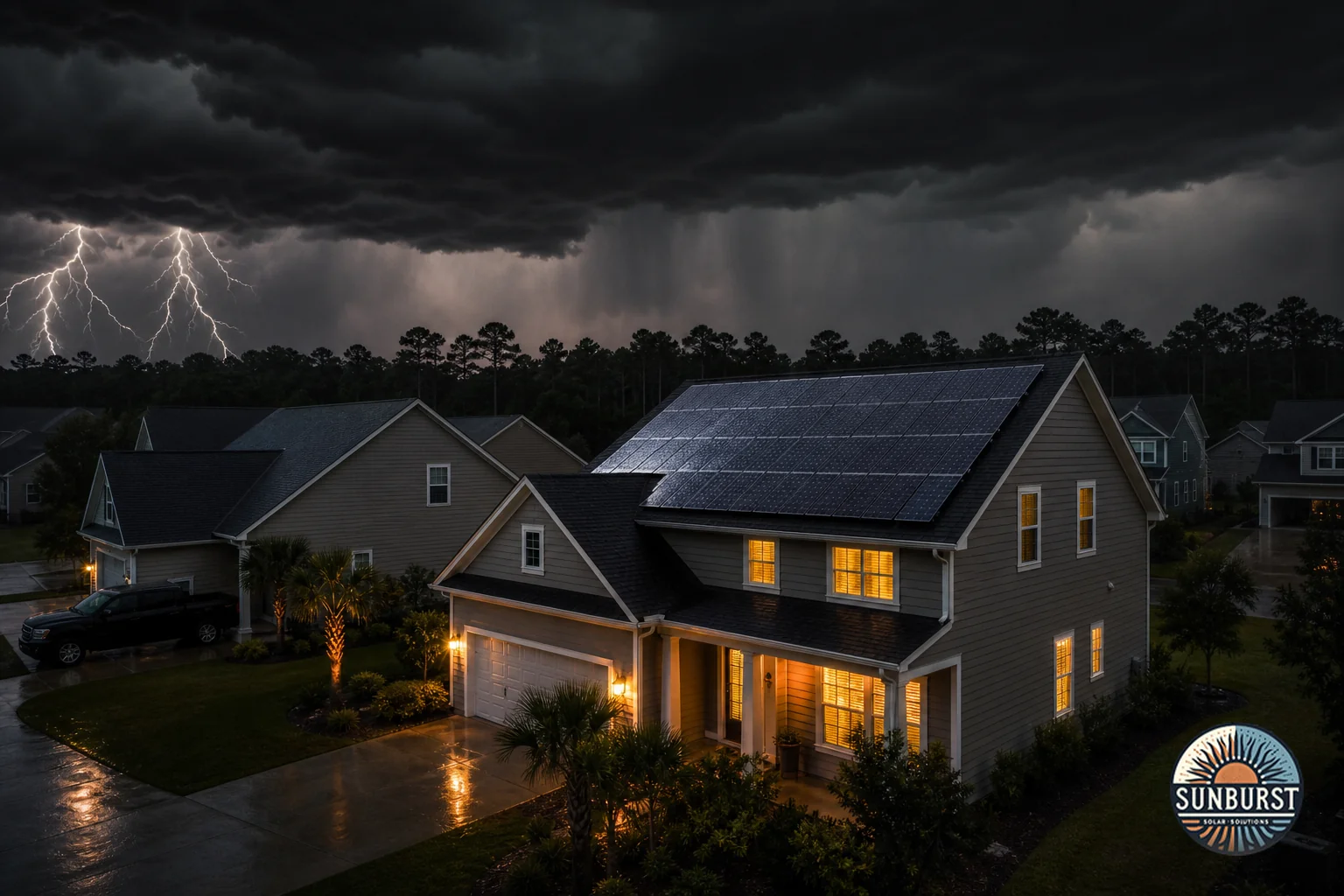
Why Grid-Tied Solar Panels Shut Off During a Power Outage
Most residential solar systems in South Carolina are grid-tied, meaning they stay connected to the utility grid and send any extra power your panels produce back into it. That connection is exactly why the system has to shut down when the grid fails. If your panels kept sending power out to the grid during a blackout, they would create what utility engineers call an “island” of live electricity on lines that repair crews assume are dead.
That’s a serious safety hazard. A lineman working to restore power expects the wires to be de-energized. Federal safety standard UL 1741 and the National Electrical Code’s Article 690 require grid-tied inverters to include anti-islanding protection, which detects a loss of grid signal and disconnects the system automatically, usually within two to ten seconds.
This is the single most common misunderstanding we hear at Sunburst Solar Solutions. Homeowners picture their panels as an independent power source, similar to a generator, when a standard grid-tied array is really just a way to offset your utility bill. It shares a safety circuit with the grid, and it shares the grid’s downtime too.
What Happens to Solar Panels During a Power Outage, Step by Step
Here is the sequence, in plain terms, from the moment the lights go out to the moment they come back:
- The grid loses power. A storm, an equipment failure, or planned utility maintenance cuts electricity to your neighborhood.
- Your inverter detects the loss. Within seconds, the inverter senses the missing grid signal and triggers its anti-islanding safety response.
- The system disconnects. Your solar array stops sending power to your home’s electrical panel, even though the panels themselves may still be generating electricity from sunlight.
- That generated power goes nowhere. Without a battery to capture it, the energy your panels produce during the outage is simply wasted. This surprises people the most: solar production and home power delivery are not the same thing once the grid drops.
- The grid comes back. Once utility crews restore power, most inverters wait a short, code-required delay (often five minutes) to confirm stable grid voltage before reconnecting your system automatically.
None of this is a flaw in your equipment. It is a deliberate, code-mandated safety feature, and it applies to virtually every grid-tied solar installation, regardless of installer or panel brand.
How Solar Battery Storage Solves the Outage Problem
Adding a battery changes the entire equation. A home battery like a Tesla Powerwall or Enphase system sits between your solar array, your home’s electrical panel, and the grid. When the grid drops, an automatic transfer switch disconnects your home from the utility line, just as before, but instead of leaving your panels stranded, it reroutes their output into the battery and then into your home.
This creates what engineers call a “microgrid”: a small, self-contained electrical system that operates safely and independently of the larger utility network. Your solar panels can keep charging the battery all day, and the battery can keep feeding your home at night, for as long as the outage lasts and the sun keeps cooperating.
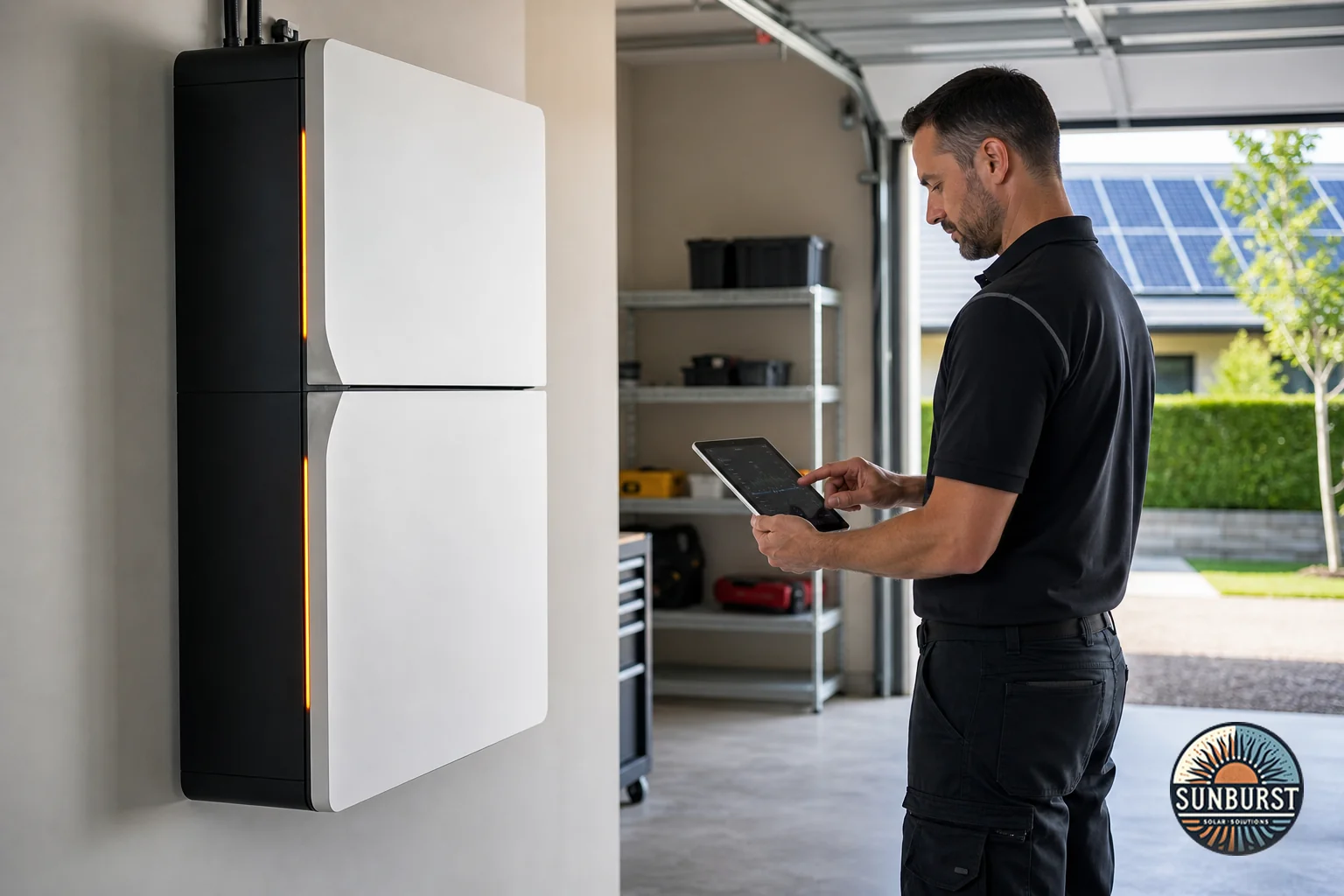
What actually stays powered depends on how the system is sized. A smaller battery might be wired to a handful of critical circuits, refrigerator, well pump, medical equipment, a few outlets and lights, while a larger battery bank can cover your whole home, including HVAC. Getting this sizing right up front matters more than most homeowners realize; our guide on how to choose a solar installer covers questions to ask any company proposing a battery system, and our detailed post on what to ask before signing a solar contract walks through backup-power clauses specifically.
Solar Battery vs. Backup Generator: Which Should You Choose?
Batteries and generators solve the same problem in different ways, and for many South Carolina homes, the right answer is both.
- Solar batteries recharge for free from sunlight, run silently, and require no fuel storage or delivery. Their limit is capacity: once depleted, they need either sunlight or grid power to recharge.
- Backup generators can produce enough power for an entire home indefinitely, as long as fuel keeps arriving, but they run on propane, natural gas, or diesel, they make noise, and they need regular maintenance and fuel logistics during extended storm events.
- Combined systems use the battery for quiet, everyday outages and let a generator take over automatically if an outage stretches into multiple cloudy days, common during a slow-moving tropical system.
For a full side-by-side breakdown of costs, runtime, and maintenance, see our post comparing solar, roofing, and battery contractor coordination, and if you’re specifically weighing options near the coast, our article on backup generator installation in Hilton Head Island covers permitting timelines and equipment choices in detail.
Is Whole-Home Backup Realistic for South Carolina Homeowners?
South Carolina’s Lowcountry and coastal counties see some of the state’s highest outage risk. Hurricane season runs from June through November, and even a Category 1 storm can knock out power across Charleston, Myrtle Beach, or Hilton Head Island for days at a time, sometimes longer if damage is widespread. According to the U.S. Energy Information Administration, average outage duration has been trending upward nationally as grid infrastructure ages and storm intensity increases, a trend South Carolina utilities have acknowledged in their own resilience planning.
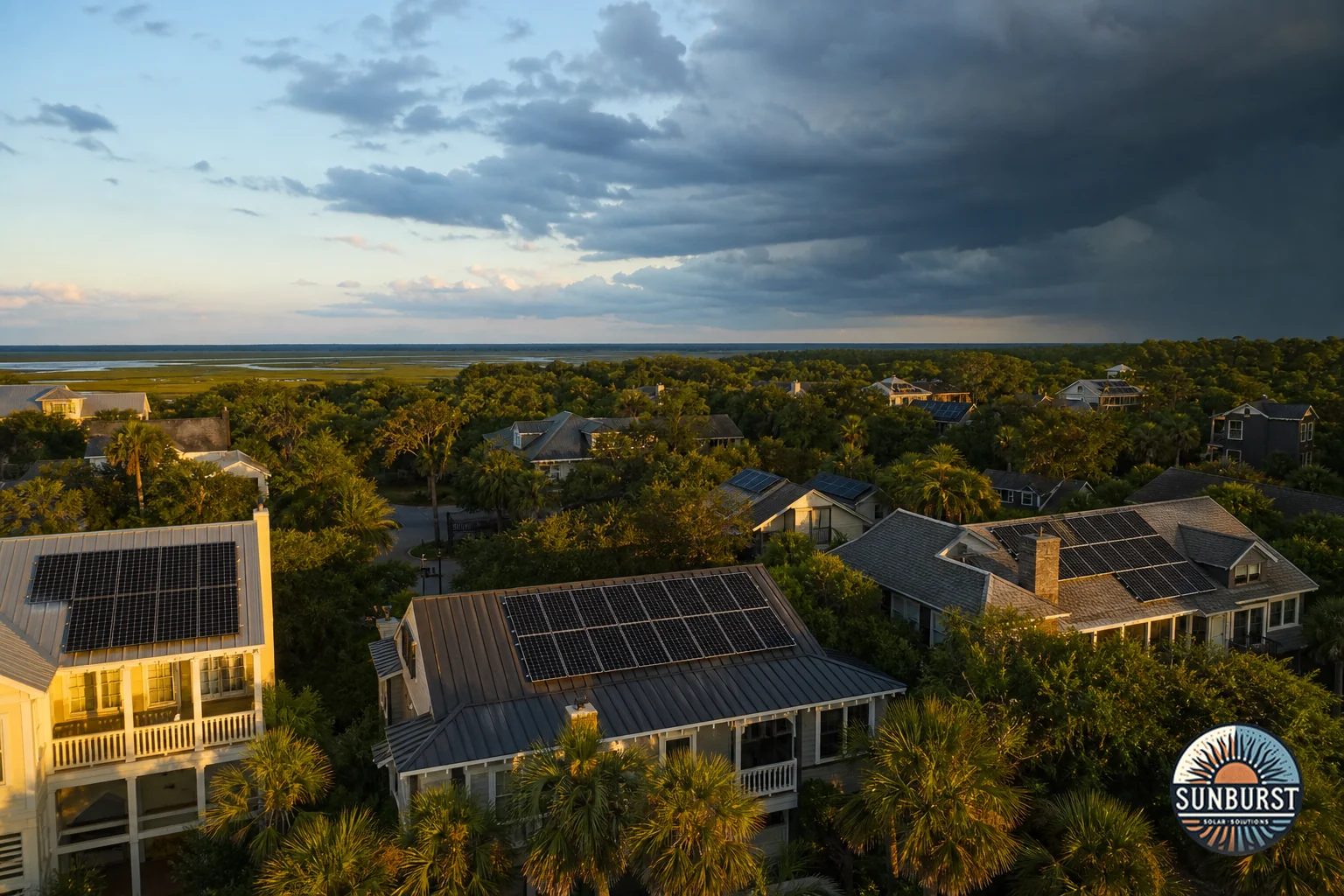
Whole-home backup is realistic, but it takes planning. A system sized only for your daily solar offset likely won’t cover a whole-home battery load; that’s a separate sizing conversation. Our guide to solar panel installation costs in 2026 breaks out how battery capacity affects your total project budget, and it’s worth having that conversation with your installer before you sign anything, not after.
Permitting also plays a role. Adding battery storage or a generator to an existing solar array typically requires an updated permit and utility interconnection paperwork, similar to the original installation. If you’re mid-project or considering upgrades to an existing home, it helps to understand the full timeline; the U.S. Department of Energy’s homeowner solar guide is a solid neutral resource on how backup equipment interacts with grid interconnection rules nationally, while local requirements vary by utility and county.
Frequently Asked Questions
Can I add a battery to my existing solar system?
In most cases, yes. Many inverters installed in the last several years are “battery-ready,” meaning a compatible battery can be added without replacing the whole system. Older systems sometimes need an inverter upgrade first. A site visit is the fastest way to know for sure.
How long does a solar battery last during an outage?
It depends entirely on battery capacity and how much you’re running. A battery sized for critical circuits only, like a fridge, a few lights, and a Wi-Fi router, can often last a full day or more between charges, and indefinitely if the sun returns before it’s empty. A whole-home battery bank running air conditioning will drain faster. This is exactly why correct sizing matters so much; see our detailed piece on how to size a battery storage system for the math behind it.
Do I need a generator if I already have a battery?
Not always, but it depends on your risk tolerance and location. Homes further inland with shorter typical outages often do fine with battery-only backup. Homes on barrier islands or in areas prone to multi-day outages sometimes add a generator as a second layer, so extended cloudy stretches during a storm don’t leave the battery running on empty.
Will my solar system restart automatically after an outage?
Yes. Once utility crews restore stable power, your grid-tied inverter waits out a short required delay, then reconnects and resumes normal operation without any action needed from you.
Sunburst Solar Solutions
If you’re comparing installers for a battery or backup-ready solar system anywhere from Charleston to Hilton Head Island, Sunburst Solar Solutions designs systems around your actual outage risk, not a one-size-fits-all package. Our team handles the full process, from site assessment through HOA documentation, permitting, and battery sizing, so you’re not left coordinating multiple contractors on your own.
A solar array without storage is a bill-reduction tool. A solar array with the right battery or generator pairing is an actual safety net for your home.
If storms in your area have you wondering whether your home would stay powered during the next outage, don’t wait for the next one to find out the hard way. Get a free assessment from Sunburst Solar Solutions, and we’ll walk you through exactly what backup setup, battery, generator, or both, makes sense for your home, your budget, and your part of South Carolina.